A perfect Fourth in Rockwood Park, by day, by Edward Kasinec
And by night, too.
Photo by Harry Bloomfeld


A perfect Fourth in Rockwood Park, by day, by Edward Kasinec

And by night, too.
Photo by Harry Bloomfeld
Boy, is Bambi’s mom gonna be ticked. Edward Kasinec noticed him (her?) and siblings, all adorable in their spots and spindly legs, in Rockwood Hall, under the watchful eye of mom (she demurred from being photographed).

Photo by Edward Kasinec
Later that day, Jane Hart just happened to be at Phelps, when who should appear but . . .


Photos by Jane Hart
No indication of whether there’s a ring leader or this was a group decision. Just don’t tell their mom.
Lynn Brady journeyed to Briarcliff for a traditional Fourth of July fireworks display. And display, it did!



Photos by Lynn Brady

Our traditional Fourth-of-July Emcee and producer of grand galas, Muriel Fox.

Frank Neuwirth read the Declaration of Independence

The Kendal Singers presented The Bill of Rights and two traditional American anthems: We Shall Overcome and America the Beautiful

Philip Monteleoni presented a new “E Pluribus Unum,” creating an American flag that stresses pride in America’s identity as a nation of immigrants.
Philip Monteleoni’s flag, excerpted from his Fourth of July remarks:
I wanted to show that we are a nation of immigrants, and it should be seen as a positive thing.
This nation was founded by people who came from elsewhere. Even the Native Americans, who were here when Europeans arrived, had come from Asia. They were the first people into this historically empty continent.
I am an immigrant, as were my father and mother. [In his new flag] our flag, Italy, is the red, white and green one sort of in the center. There are 77 national flags, out of many more, arranged alphabetically, starting with Afghanistan on the upper left and ending with Vietnam at the bottom right. They speak to the amazing and rich potpourri, or melting pot, that fuels the energy and creativity of our beloved nation.
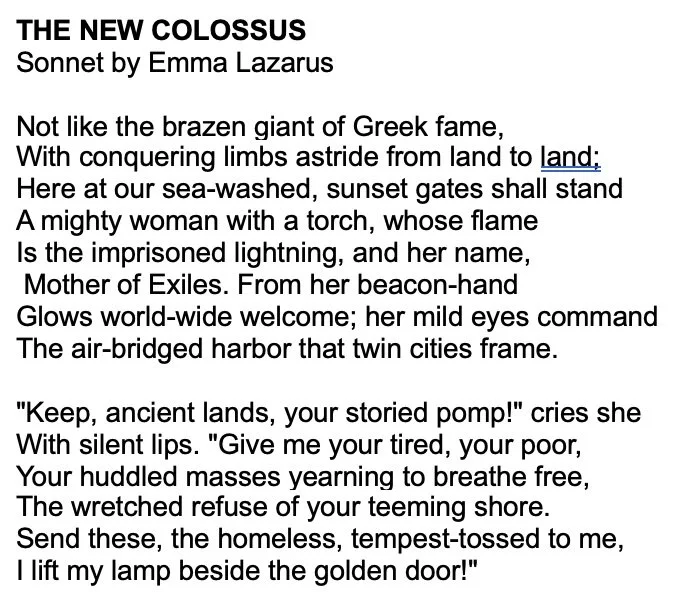
At this moment of persecution and hounding of our latest immigrants–don’t forget, we are all immigrants–I would like to read the poem that Emma Lazarus, in 1883, composed to raise money to build the masonry base for the gigantic copper statue that France had sent over as a gift to celebrate the first centennial of our democracy, and our abolition of slavery during the Civil War.
She entitled her poem, THE NEW COLOSSUS. Yes, the last six lines have been overused and are too familiar, but I wish to read the whole 14 lines, which are in standard sonnet form.
The flag for a nation of people who came from someplace else (and the nations from which they came outline below it):

Contributed by Philip Monteleoni

The Goldenaires present a new, revised, 2025 version of “I’m Gonna Wash That Man . . .”
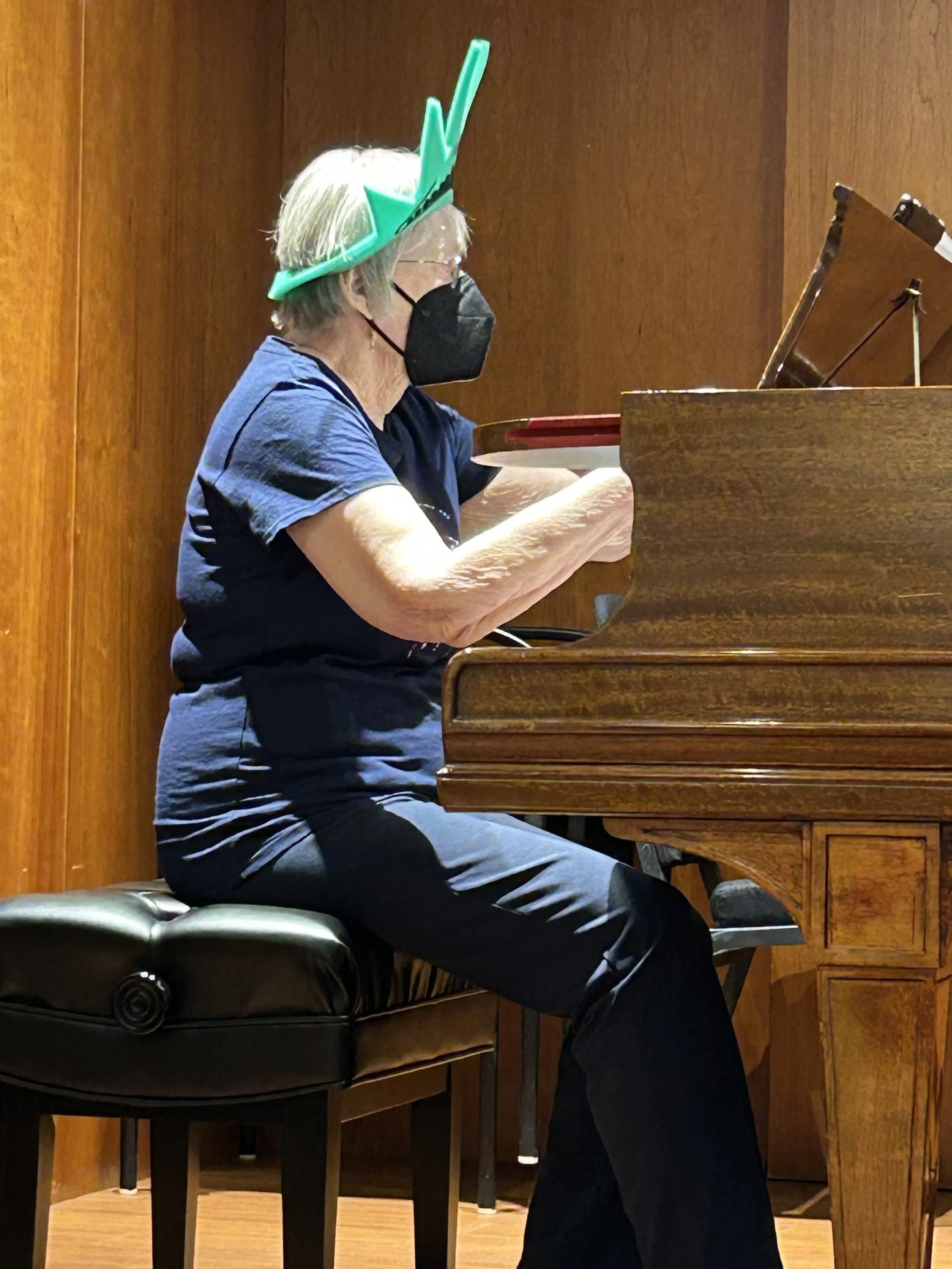
The Statue of Liberty was busy that night, so Ginny Bender stood in for her. Oh, yes, and Ginny also provided the piano accompaniment.
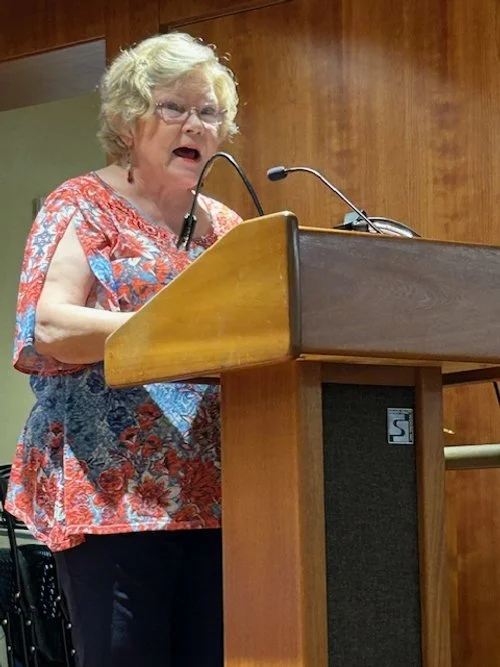
Bobbi Roggemann discussed the odd friendship/competition between two of our greatest founders: Thomas Jefferson and John Adams

In our annual Fourth of July “Debate” the topic was “Does the US Supreme Court Need Fixing and What Would Be the Best Way to Do It?”
Carol Monteleoni presented the argument for increasing the size of the Court.

Stan Amberg presented the argument for maintaining the status quo.

Anne White presented the argument for term limits.
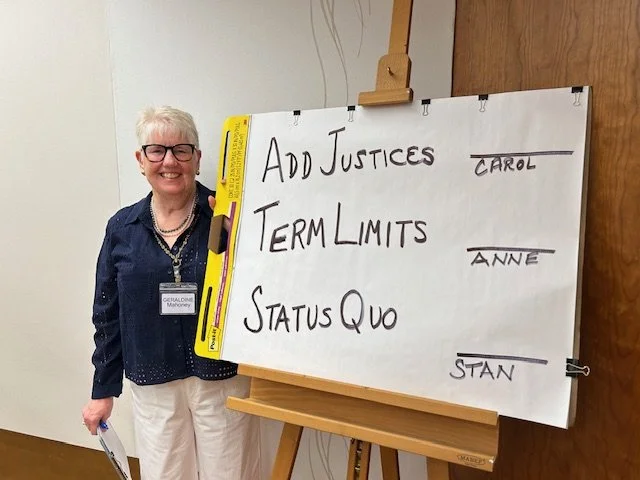
Gerry Mahoney added up the votes and . . .

Term limits took the day (or night).
Photos by Carolyn Reiss
If Adam and Eve were Cajuns, they would have eaten the snake instead of the apple and saved us all a lot of trouble.
We celebrated last night with a couple of adult beverages: Metamucil and Ensure.
Weight loss goal: To be able to clip my toenails and breathe at the same time.
After watching how some people wore their COVID masks, I understand why contraception fails.
Some of my friends exercise every day. Meanwhile I am watching a show I don’t like because the remote fell on the floor.
For those of you who don’t want Alexa or Siri listening in on your conversation, they are making a male version. It doesn’t listen to anything.
The pessimist complains about the wind. The optimist expects it to change. The realist adjusts his sails.
To be continued . . .
Contributed by Barbara Wallach
In the ongoing shocking goat-sex exposé, we have received news that The Billy has arrived. Investigative photographer Carolyn Reiss has been able to capture photos of him in silhouette and, later, closer up. As you can see, he is short, dark, and handsome-ish (well, for a goat). We await the next step.

All alone on a hilltop

Up closer and personal
Photos by Carolyn Reiss
Many of us know of and are amazed by Marilyn Bottjer’s skills in the fiber arts. If you don’t know her work, visit the mermaid rug hanging on the C-level wall in the hall leading to the hair salon. Or check out her contributions to the Summer Art Show. What those in the know—and those not in the know—might never expect would be that Marilyn herself would be pictured in a rug.
But she is now!

Titled Marilyn Bottjer: Tokens of Friendship, the work is by Liz Alpert Fay whose show of 16 large-scale, multidimensional portraits honored extraordinary yet often overlooked women, celebrating their individuality and the artist’s evolution. Her work was featured recently at the Silvermine Art Center in New Canaan, CT. Fay created Mayilyn’s portrait in 2019. Wool on linen, hand-hooked, it measures 102” x 67”.

Sadly, the exhibit has now moved further west. Its creations honor what Fay says are the extraordinary achievements of women in the ordinary context of their lives.
If you would like to see other portraits in the show, you can do so by clicking below.

King Louis XIX of France holds an unfortunate record: the shortest reign of any monarch in history. Born Louis Antoine in 1775, he was technically king of France for a mere 20 minutes—in 1830, following the abdication of his father, Charles X, during the July Revolution. The dauphin abdicated his right to the throne in the same document, which he signed 20 minutes after his father. (Legitimists—supporters of the Bourbon dynasty—didn’t accept this and considered him the rightful king for the rest of his life.)
On the other end of the world-record spectrum is Sobhuza II, whose 82 years and 253 days as both paramount chief and king of Swaziland make up the longest verified reign of any monarch in recorded history.
Some consider Louis XIX’s record to be a shared one, however. Luís Filipe, prince royal of Portugal, was fatally wounded in the same attack that killed his father, King Carlos I, on February 1, 1908, but survived 20 minutes longer. The 20-year-old was technically king for those few minutes, though he was never formally declared ruler. His younger brother Manuel II became the last king of Portugal on that fateful day instead. His reign wasn’t especially long, either: Portugal became a republic as a result of the October 5, 1910, revolution, and Manuel spent the remainder of his life exiled in England.
Source: historyfacts.com
Contributed by Jane Hart





Contributed by Barbara Bruno


Compassion V

Compassion VI
Art and photo by Sheila Benedis
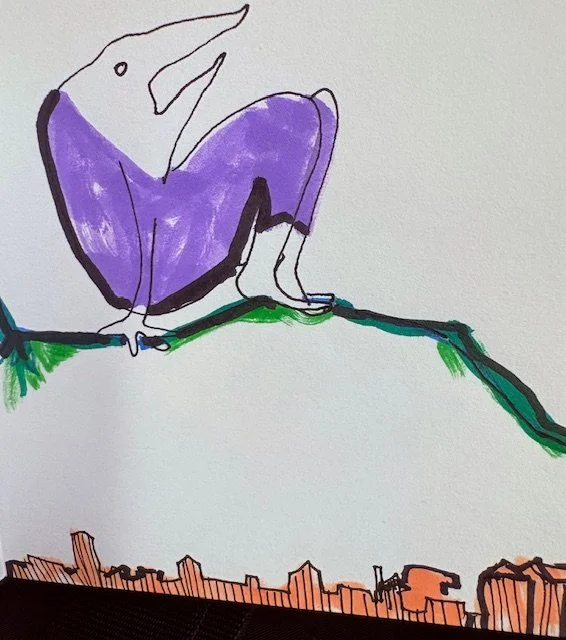
Vincent wasn’t thrilled with his transfer to a branch office

Tourist season was in full swing

The Pignat-Sharpes were new to birding

Snapping the Finge family reunion photo was always a challenge

Mabel couldn’t resist a single cute outfit, 50% off
Art and photos by Jane Hart

Take a bunch of goats, put them with a felled tree, and you quickly have a log-rolling contest. Or, anyway, it looked like that to Edward Kasinec, who sent in the above picture of goat athletes.
Photo by Edward Kasinec

Clermont’s latest puzzle completed!
Photo by Peter Sibley

Photo by Carolyn Reiss

A show of Priscilla Holmgren’s calligraphy is now on display in Clearwater. Here, the artist on opening day.
Photo by Harry Bloomfeld
It was Carolyn Reiss who recently spotted the shocking plotting and planning underway in Rockwood Park. The lady goats there were happily (we assume) grazing one lovely spring morning when a mysterious van pulled into their meadow.

Slowly the area was narrowed by moving the wire fencing, and the gals wandered innocently toward the van.

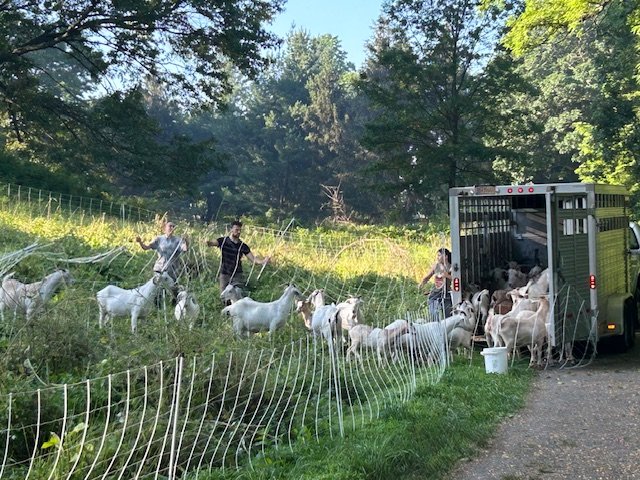
Once the gals were inside, the van was closed as suspicious characters “checked” its inhabitants, slowly rejecting the older goats (just imagine their humiliation) and the youngest ones, too (well, thank heaven for that). The others were identified as “available” and released.
Res Web has learned from an anonymous source (okay, it was Carolyn), that the girls identified as “available” will soon be made so for a—hold on to your hat—Billy goat. Yes, we know. Shocking beyond belief. Sigh. Stay tuned for birth announcements.
The biggest joke on mankind is that computers have begun asking humans to prove they aren’t a robot.
When a kid says “Daddy, I want mommy” that’s the kid version of “I’d like to speak to your supervisor.”
It’s weird being the same age as old people.
Just once, I want a username and password prompt to respond “CLOSE ENOUGH.”
Last night the internet stopped working so I spent a few hours with my family. They seem like good people.
To be continued . . .
Contributed by Barbara Wallach

From the Office of Ellen Ottstadt

Ancient Greek and Roman statues are still awe-inspiring thousands of years later—arguably even more so because of their age. Still, the pieces that have survived the test of time didn’t do so with all their colors, extremities, accessories, or, it turns out, smells intact.
Ancient sculptors used a variety of oils, waxes, flowers, and herbs to add olfactory dimension to their work, and roses were an especially popular fragrance. A 2025 study published in the Oxford Journal of Archaeologyshined a light on the practice, but ancient texts by the likes of Cicero, Pliny the Elder, and others also mention perfuming statues of deities and rulers. The ancient Greek scholar Callimachus once noted, for instance, that a statue of Egyptian Queen Berenice II was “still wet with perfume.” In a practice they called kosmesis, ancient Greeks would lavishly adorn statues of deities with jewelry, textiles, and oils as a part of religious observances, and perfuming was often included in this ritual. In the Delian temples on the Greek island of Delos, worshippers used a perfume called myron rhodion, made from oil, rushes, and rose petals. Some statues’ smells came from garlands of fresh flowers. Other scents came as a result of normal maintenance, since people would preserve statues by rubbing them in wax and oil, sometimes with pungent additives such as spikenard (aka muskroot).
Scent held deep significance in the lives of ancient Greeks and Romans, from the perfume they adorned themselves with to the smells of animal sacrifices sent up to the gods—so it only follows that their works of art would integrate smell as well.
Source: historyfacts.com


Contributed by Cynthia Ferguson



The striped-bass costume allowed Wilberforce to observe pond life undetected

Danielle loved her Sunday mornings on the water

Nick and Jefferson had a terrific collection of jokes

Pingry had never lost sight of his third-grade sweetie

Carlsrud wished he’d spent the extra money for a quieter hat
Art and photos by Jane Hart
Carolyn Reiss and her pup, Allie, take early morning strolls in Rockwood Park. The park never fails to intrigue, inspire, and entrance.

The early morning sun breaking through the mist

Six-to-eight-feet away from a human and a small white dog, but this park denizen seems more curious than frightened

Photo by Carolyn Reiss

Roadside Dining, by Edward Kasinec

Our summer visitors—the goats—enjoying a well-deserved rest, by Edward Kasinec

Becoming as natural to see as his (her?) neighbors, the goats, by Mimi Abramovitz

Photo by Mimi Abramovitz

Beware: poison Ivy growing on the path in front of Mary Powell, by Carolyn Reiss

They’re b-a-a-a-c-k-k! The poison ivy you’ll want to avoid. But, by all means, step on the newly hatched spotted lanternflys!
Photo by Martin Smolin

Sunset seen from a Kendal balcony, by Barbara Wallach
Recently, Kendalites journeyed to a favorite Yonkers spot: the Untermyer Gardens. Philip Monteleoni captured a couple of reasons why it is a favorite spot.

The dome from the inside out
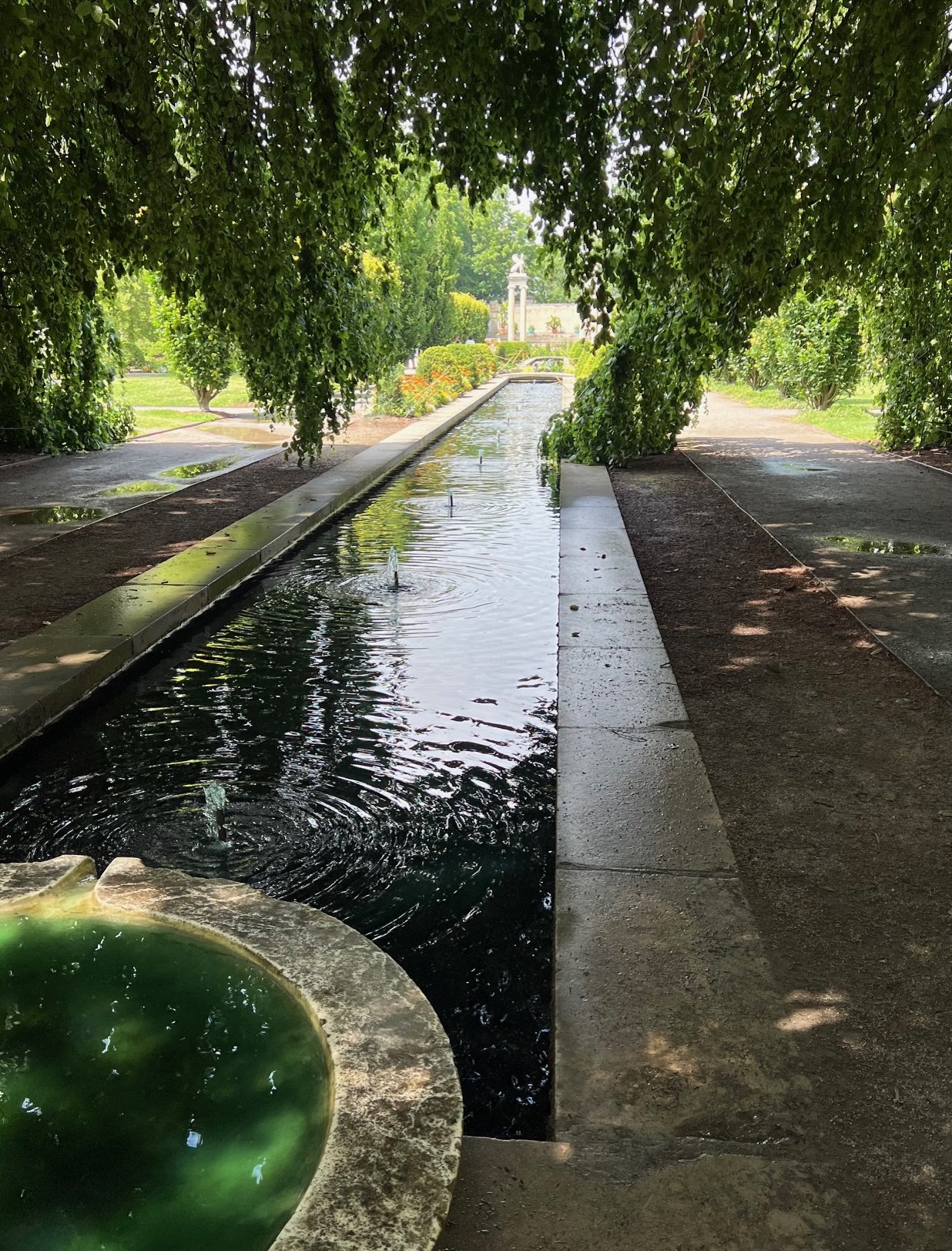
The essence of beauty
Still trying to get my head around the fact that “Take Out” can mean food, dating, or murder.
The older I get, the more I understand why roosters scream to start their day.
You know you’re over 50 when you have “upstairs ibuprofen” and “downstairs ibuprofen.”
If only vegetables smelled as good as bacon.
I woke up this morning determined to drink less, eat right, and exercise. But that was four hours ago when I was younger and full of hope.
Anyone who says their wedding was the best day of their life has clearly never had two candy bars fall down at once from a vending machine.
To Be Continued . . .
Contributed by Barbara Wallach
© Kendal on Hudson Residents Association 2015, 2016, 2017, 2018, 2019, 2020, 2021, 2022 all rights reserved. Please do not reproduce without permission.
Photographs of life at Kendal on Hudson are by residents.