Rays from Heaven, by Edward Kasinec
A New Kendal Resident?
Photo by Joe Bruno
In the Spring, a young man’s fancy . . .
Photo by Mimi Abramovitz
Looming Green, by Edward Kasinec
New in the Bistro, by Joe Bruno
Good Night, Kendal.
Photo by Sue Bastian


Rays from Heaven, by Edward Kasinec

A New Kendal Resident?
Photo by Joe Bruno

In the Spring, a young man’s fancy . . .
Photo by Mimi Abramovitz

Looming Green, by Edward Kasinec

New in the Bistro, by Joe Bruno

Good Night, Kendal.
Photo by Sue Bastian
On recent Kendal trip to the Cooper Hewitt Museum , Kendalites visited an exhibit from the Lenape Center. Placed directly across from the museum’s entryway, this installation pays homage to the Lenape people as the original and rightful stewards of Lenapehoking, the land on which this building stands. Accounts written by European explorers in the 16th and 17th centuries described the Lenape wearing intricately constructed feather capes. Joe Baker, co-founder of the Lenape Center, has created contemporary interpretations of these turkey-feather capes that suspend from the ceiling.
Carolyn Klinger sent pictures of these amazing feather capes:
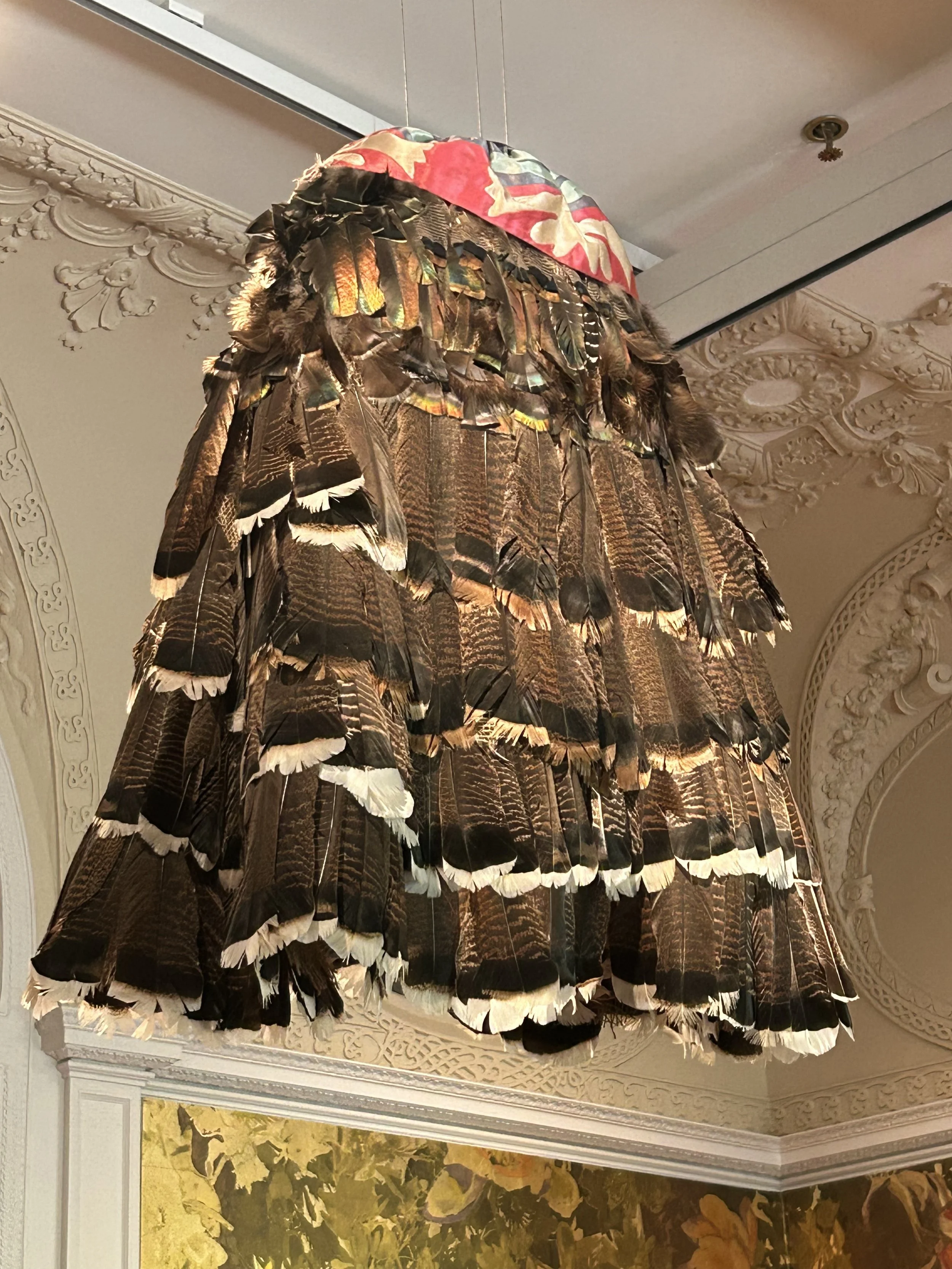
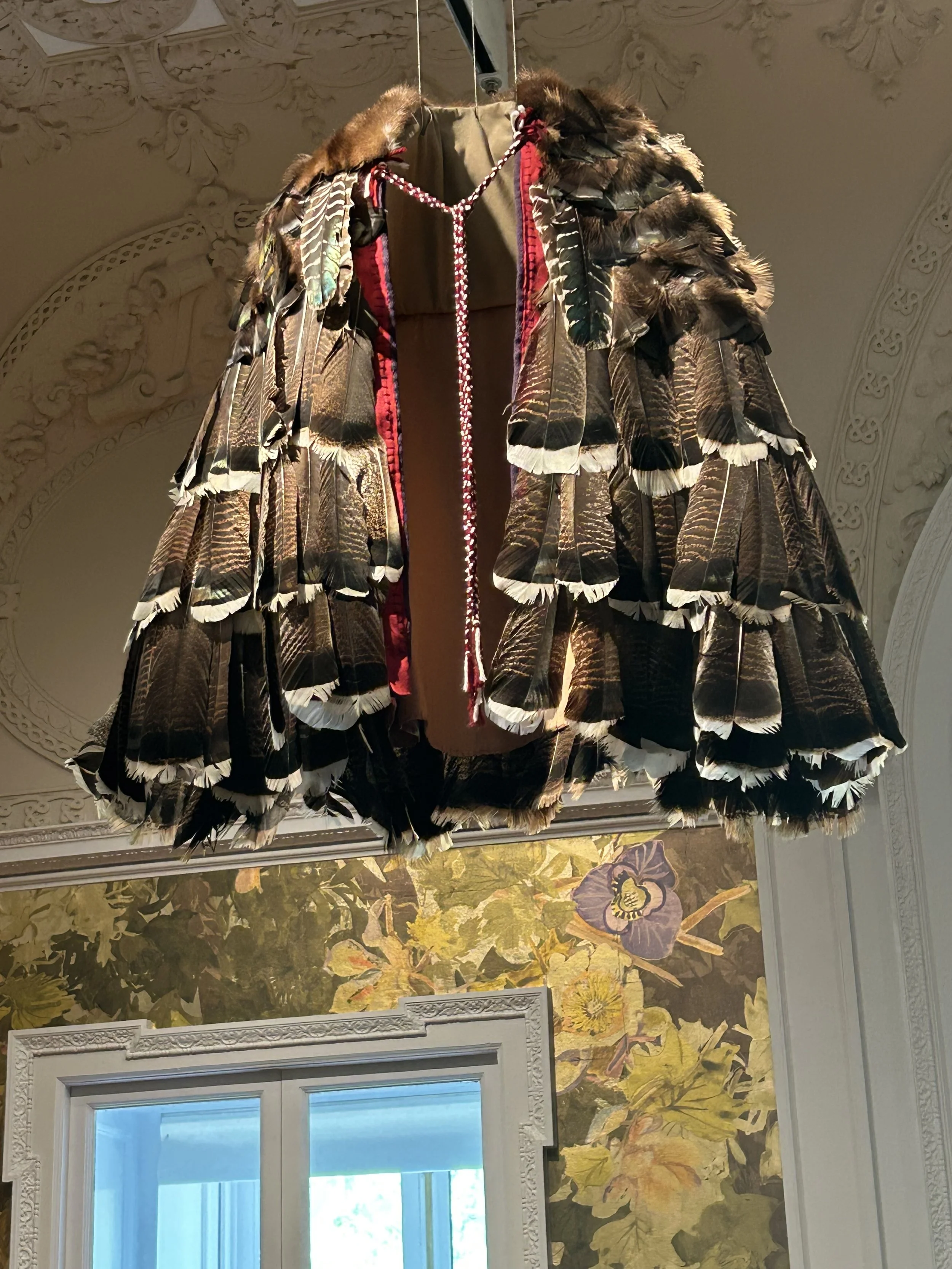

Fresco of William Penn and Tamanend and other Lenape Sachems (chiefs), as portrayed in the rotunda of the U.S. Capital, in Washington, D.C., by Constantino Brumidi
Interested Residents are cordially invited to come together in the Gathering Room on Friday, May 9, from 1:30-2:30 pm, for the organizational meeting of a new Resident’s Committee. [Questions: Nick Robinson, KoH 4015]
Established by the Residents’ Council on this past Earth Day, April 22, this new Committee has the following mission:
“The purpose of the Committee on the Lenape is to foster friendship between Kendal on Hudson residents and the Lenape, whose ancestral lands include the region where Kendal on Hudson is located. The Committee will build and sustain a continual engagement with the culture, history, and well-being of the Lenape through educational and other activities, and will coordinate activities with other Residents’ Committees where relevant.”
LENAPE Heritage and Kendal on Hudson
Kendal on Hudson dates back 20 years. Lenape lived in Lenapehoking for some 8000 years. The Munsee Lenape were driven out by Dutch colonial governments, and then the British, and then the Americans. We live and work on the ancestral lands of the Lenape, near the Pocantico river was the Lenape community of Alipoonok (also referred to as Aneebikong, a place of trees). Oaks at Rockwood Hall State Park harken back to these times. Lenapehoking’s tribal communities extended from the Hudson River (Manhattan to the Catskills), across New Jersey and Delaware to the Delaware River (Philadelphia to the Water Gap).
The Delaware Lenape and William Penn agreed the historic Treaty of Shackamaxon in 1682, based on Quaker values: equal respect and love for each individual, peace, fairness, consulting one another as friends, in perpetuity. In the American Revolution, the Continental Congress sought the 1778 Treaty with the Delaware (Fort Pitt). Lenape were allies to fight the British on the western frontier. This was the very first US treaty with any Indian Tribe, only America’s second treaty ever (the first being with France). Throughout, the Lenape have honored their pledge of friendship, serving in the Union Army in the Civil War and guiding the Frémont expedition as it explored the west.
Greed for Lenape lands, and warfare along the western frontier of the USA, forced the Lenape repeatedly to move westward, across the Mississippi. From perhaps 100,000 Lenape in Penn’s day, today only 15,000 remain in three federally recognized tribes in Oklahoma and Wisconsin and in three First Nations recognized by Canada in Ontario. None remain in the Hudson Valley, where Kendal on Hudson is situated today. We would welcome the Lenape as friends.
We at Kendal on Hudson have been honored to receive a Lenape Chief, Curtis Zunigha (Delaware Tribe of Indians), in 2023, to learn from a Monday evening lecture in 2024 by Hadrien Coumans (a co-founder of the Lenape Center and adopted member of the Delaware Tribe) and to welcome the distinguished composer Brent Michael Davids, (Stockbridge-Munsee Tribe), during his residency at Coplan House in 2025. We admire how Lenape culture and values have persisted, evidence of a resilient and wise People. Ours is a special relationship.
Sources: Joe Baker, et al., Lenapehoking: An Anthology (Brooklyn Library, 2023) in the KoH Library; and J.W. Brown and R.T Kohn, eds, LONG JOURNEY HOME – Oral Histories of Contemporary Delaware Indians, (Indiana Univ. Press 2008); Robert S. Grumet, The Lenapes (1989); H.C. Kraft, The Lenape (N.J. Hist. Soc., 1986); C.A. Weslager, The Delaware Indians (Rutgers Univ. Press 1972), and Anne Dalton, The Lenape (2005).


The aim is fun, not financial windfall. Fear not any Atlantic City high-rollers joining in. All skill sets are welcome. Stakes are 25-50 cents.
Want to join the fun? Call or text John Vacher: (404) 556-0557. He’ll even come and provide a short tutorial, so you’ll fit in seamlessly your very first Wednesday night.
There is now a way out to the Terrace on the T-Level! Or will be once Refresh is completed.

And here’s the hallway that leads past the Fitness Center (right) and the pool (left).


A Refresh Reminder From Ellen Ottstadt
This past week, so many pictures came in featuring the beauty of our Kendal neighborhood that we thought we’d make an entire segment of them.

Photo by Joe Bruno

Photo by Carolyn Reiss

Photo by Carolyn Reiss

Photo by Mimi Abramovitz

Photo by Mimi Abramovitz

Photo by Mimi Abramovitz

White Torch, by Edward Kasinec

Outside Sunnyside, by Joe Bruno

Photo by Joe Bruno

Most dates that are recognized as national holidays or at least entail widespread celebrations can enjoy that particular 24-hour designation to themselves on the calendar. It’s rare for a widely acknowledged holiday—say, Halloween or Presidents Day—to share top billing with another commemoration. Which brings us to the outlier of May Day.
For hundreds of years across much of Europe, May 1 was celebrated as a time when spring was in full bloom, with outdoor communal festivities highlighting the merriment enjoyed by participants who no longer had to fear winter’s wrath. However, for more than a century now, May Day has had a more serious significance. Also known as International Workers’ Day, it’s recognized as a time to mark the ongoing struggles for improved labor conditions—and, by extension, human rights. Although neither version of May Day is formally acknowledged as a holiday in the United States, both are more widely known internationally, and in some areas dually celebrated. So, what exactly is May Day, and how has the significance of the day evolved?
May Day Originated From Pagan Celebrations
May Day as a commemoration of spring has its origins in older pagan traditions. The Romans celebrated the six-day festival of Floralia from late April into early May, an event marked by various competitions, theatrical presentations, and the releasing of hares and deer as symbols of fertility. Farther north, the people of Ireland, Scotland, and the Isle of Mann celebrated May 1 with the Gaelic festival of Beltane. Marking the start of summer, Beltane was traditionally observed with the lighting of bonfires and collection of flowers. By the late Middle Ages, these events had coalesced into the May Day celebrations that were held through much of Europe. Perhaps the most famous rite associated with the day is dancing around the maypole. First noted in the 14th century, the maypole was originally a full tree hauled into a village, before evolving into a shorn wooden pole. Other May Day traditions surfaced later, including the appearance of the Jack-in-the-Green and the selection of the May Queen.
Source: historyfacts.com
Contributed by Jane Hart


Contributed by Maria Harris

Art and photo by Sheila Benedis

Vanessa was proud of how Booboo’s penmanship was improving

Mitzi and Lombard had to hide their love behind a passing cloud

A kind woman, Noah’s wife sneaked several of her small single friends aboard the ark

Richardson was not a fan of the new subway lighting

Just as Granny Finch-Baum warned, Dennis turned into an ice cream cone
Art and photos by Jane Hart

Green Again after a Long Winter, by Greg Lozier

Alive, Well, and Blooming Afresh, by Carolyn Reiss

Visiting the Local Pileated-Woodpecker Deli, by Lisa Rosenbloom

Lilac Beauty in Our Neighborhood, by Greg Lozier
Friday, April 25, was the time for grace and elegance—and fancy headgear, too. The second Kendal Afternoon Tea was a hit! The atmosphere was gracious, the delicacies delicious, and the hats and fascinators tasteful and appropriately spring-time. Fred and staff outdid themselves, once again. To the planners we say a heartfelt YAY! And thank you. As we do to Fred et al for carrying it out to a tee.

Tea-time Menu


Fred actually sat down—for a moment


Stay tuned: Fred has promised us his scone recipe.
Photos by Greg Lozier

Here’s the chance you’ve been waiting for: The five-member Investment Committee of the Residents Association has an opening for a member of the community who has prior experience and expertise in the world of money management.
Interested? Please put a note in Tom Wolzein’s cubby, x4316, by Friday, May 2.

Sometimes “out of the attic” comes a memory of the work-world past.
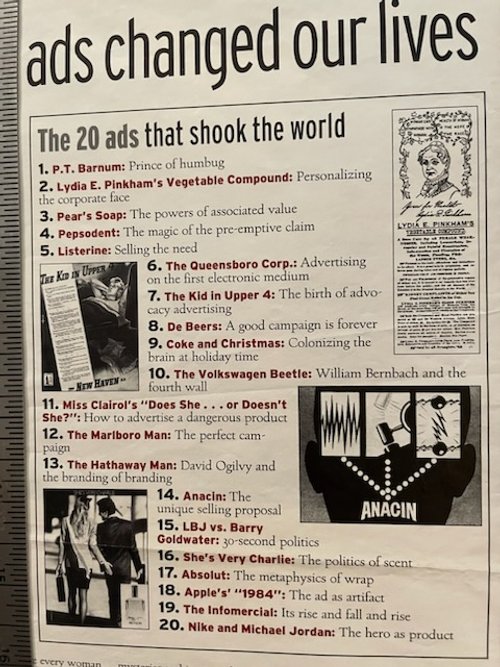
The time was 1973. Revlon was joining what was then a world-changing movement now best known as The Women’s Revolution. It did so by deciding to change the face of traditional perfume advertising. Charlie perfume was born—and, with it, the Revlon Charlie perfume ad featuring a confident, modern woman plowing happily and forcefully through the world on her very own.
Fast forward to 1988. A new Charlie campaign, designed by our own Cathie Campbell, hit the market. It featured a woman patting a man on the backside, a playful representation of female self-sufficiency.

Revolutionary! It took the powers that be by surprise—and a wee bit of consternation—as depicted in a sketch Cathie did at the time of those to whom she presented the ad for approval (naturally, after the usual 3-martini lunch).

It was in the end accepted and pitched into the world. Playful? A paean to self-suffiency? Whoa! Not all agreed. There were those—The New York Times, for example—who criticized it as sexist and in poor taste. And the reaction, in turn, was dramatic.

And the ad campaign was a hit! And a significant marketing move for Revlon: within three years, Charlie became the world’s top-selling perfume. And in the ad world, too, making #16 in “The 20 Ads That Shook the World” list from Adweek.
They came, they saw, they volunteered. And then they talked about it.
At the recent Residents Association Quarterly meeting, Carlisle Spivey chaired a panel of four residents who have helped build the spirit, energy, and actuality of community here at Kendal: Marianne Bloomfeld, Caroline Persell, Peter Roggemann, and Tom Wolzien. They talked among themselves about what they had expected from Kendal, how they had entered into the community, and what advice they’d have for new residents.


Photos by Harry Bloomfeld


The aim is fun, not financial windfall. Fear not any Atlantic City high-rollers joining in. All skill sets are welcome. Stakes are 25-50 cents.
Want to join the fun? Call or text John Vacher: (404) 556-0557. He’ll even come and provide a short tutorial, so you’ll fit in seamlessly your very first Wednesday night.

You can send a lot of things in the mail, but you can’t send a person—at least not anymore. There was nothing preventing people from mailing their own children in the early days of the US Postal Service’s parcel post service, though, and at least seven families took advantage of it. That includes the Beagues, an Ohio couple who in 1913 paid 15 cents in postage to mail their newborn son to his grandmother’s house a mile down the road. Beyond the novelty of it—when the parcel post service began on January 1, 1913, some were eager to see which packages they could get away with sending—it was a surprisingly practical way of getting one’s kiddo from point A to point B.
To start with, many people in rural areas knew their postal carriers fairly well, which meant the children were simply walked or carried on often-short trips. In other instances, children traveled on trains as Railway Mail, but with stamps instead of (usually more expensive) train tickets.
The longest known trip of a child through the mail occurred in 1915, when a 6-year-old was sent 720 miles from Florida to Virginia—a lengthy trip that cost just 15 cents.
Fortunately, there are no reports of children being injured by being sent through the mail. (Pictures of children in literal mailbags were staged.) The practice ended, as so many do, when certain higher-ups became aware of the loophole and decided to close it, also around 1915.
Source: interestingfacts.com
Contributed by Jane Hart
© Kendal on Hudson Residents Association 2015, 2016, 2017, 2018, 2019, 2020, 2021, 2022 all rights reserved. Please do not reproduce without permission.
Photographs of life at Kendal on Hudson are by residents.