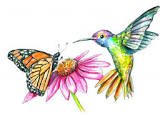
Two small but beautiful and colorful flying creatures share the spotlight on Butterfly and Hummingbird Day. It may seem odd to honor them together, but, besides being attractive, they’re both great flower pollinators.
There are about 20,000 species of butterflies, some sources say 17,500; others, as many 24,000. There are about 750 species in the US, where the white cabbage butterfly is the most prevalent. The life cycle of a butterfly begins with eggs laid on leaves, which hatch into larvae — known as caterpillars — that eat those leaves and flowers, and grow in size, shedding their skin many times. Next phase: pupa — or chrysalis, from which they finally emerging as butterflies.
Out of the cocoon, butterflies pump fluid into the veins of their wings to expand them, then rest for a few hours before taking flight for the first time. Cold-blooded, chilly air affects butterflies’ ability to function. Below 55 degrees, their body temperature may drop too low to enable flight. Like many of us, they may warm by shivering or by lounging in the sun. Between 82 and 100 degrees is their best range.
Butterfly wings have thousands of scales that reflect light, giving them color. Underneath those scales, their wings are actually transparent. Some butterflies fold their wings in to help camouflage themselves from predators. Others have bright colors so that some predators, aware that many bright-colored insects are toxic, will avoid them, even though they’re not actually poisonous.
Butterflies generally have short lives. Most only living for 2 – 4 weeks, during which they mainly eat and mate. Not an altogether bad life. Some butterflies only live a few days, while some that migrate — like Monarchs and Morning Cloaks — may live about 9 months. Monarchs may travel over 2,500 miles to find warmth during the colder months.
Hummingbirds — from the family Trochilidae — are birds from the Americas. They are the smallest of bird species. Most hummingbirds measure 7.5 – 13 cm (3” – 5”) in length. The smallest of the species is the bee hummingbird (native to Cuba), measuring 5 cm (about 2”) and weighing less than 2.0 g (0.07 oz). There are about 325 species of hummingbirds, but only 8 of them regularly breed in the US. Like butterflies, hummingbirds may fly hundreds or even thousands of miles to migrate, which means that up to 2 dozen species can be found in the US at various times. Most hummingbird species come from South America, Central America, and the Caribbean. There are no hummingbirds outside of the Western Hemisphere. Many species can breed together, which creates hybrid species.
Each hummingbird species makes a different humming sound because the wings of each species beats at a different rate. Generally, a hummingbird's wings beat somewhere between 50 and 200 times a second. Wings aren't the only things that beat quickly when it comes to hummingbirds: their hearts beat more than 1,200 times a minute. They also take a breath about 250 times a minute, and that number is even higher when they are flying. Their lifespan ranges from 3 to 12 years and is contingent on factors such as their species, habitat, and vulnerability to predators.
Hummingbirds eat a variety of insects: in flight, mosquitoes, fruit flies, and gnats, or aphids on leaves and spiders in their webs. They drink nectar from flowers, but can also be enticed by sugar water in a feeder, so their beauty can be enjoyed up close.
Hummingbirds have such small feet that they can't walk or hop properly. Their feet are mainly used for preening. However, their small feet also allow them to fly quicker — up to 30 miles per hour when going forward, and up to 60 miles per hour when diving.
OCTOBER 4: RANDOM ACTS OF POETRY DAY