
The Formation of the Principality of Sealand
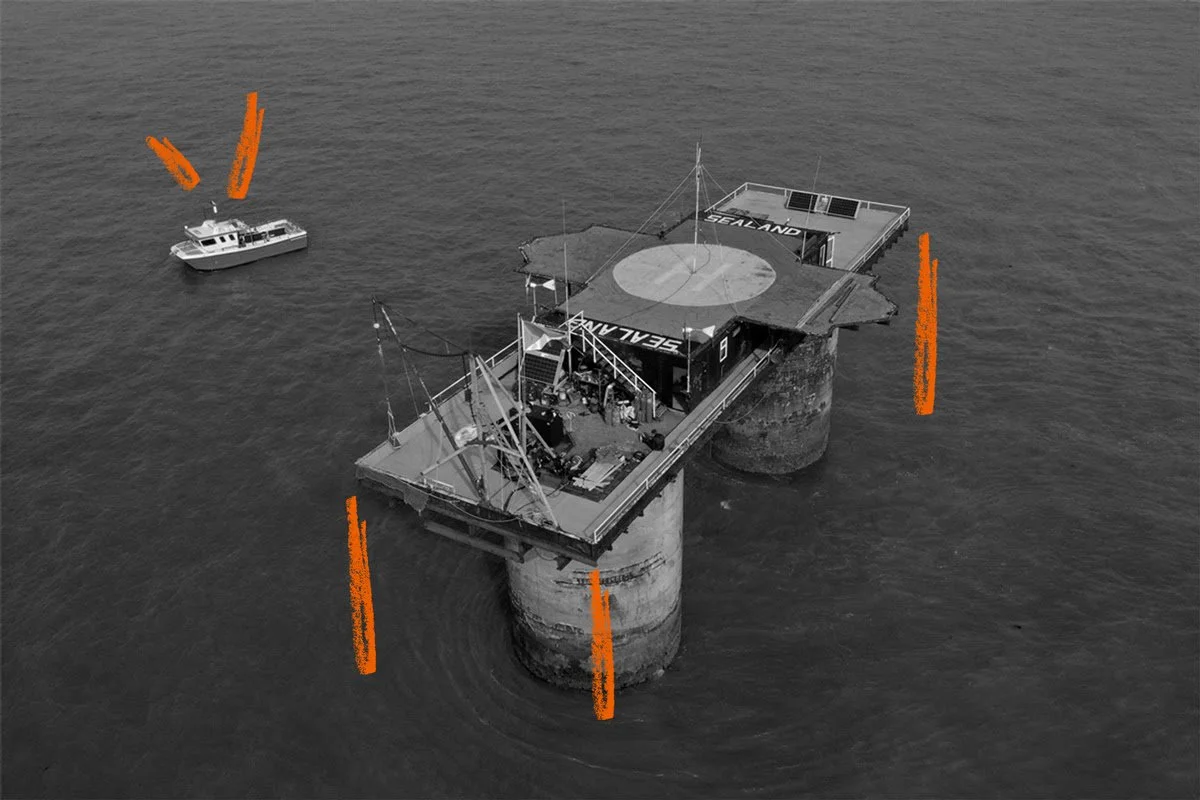
There is a micronation on a fortress at sea off the coast of Great Britain, and the British government once considered blowing it up.
During World War II, a series of sea forts was built to shoot down Nazi bombers. These structures were cylindrical towers of concrete and steel. One of these, Roughs Tower, sits 110 feet above sea level, off the coast of Suffolk in the North Sea.
After the war, these forts were largely abandoned. To British army major Paddy Roy Bates, Roughs looked like an ideal spot for a pirate radio station. In the 1960s the BBC dominated radio in Great Britain as the country’s only licensed broadcaster. The station played popular music only at night, irking listeners and causing pirate radio stations to proliferate. Bates first set up a pirate radio station at Knock John, another sea fort. He was evicted, prosecuted, and fined in 1966. That’s how he ended up at Roughs: At 6.5 nautical miles offshore, it was outside the standard territorial reach.
Bates declared the platform the Principality of Sealand and asserted its sovereignty as a micronation distinct from Great Britain. He named himself prince and his wife, Joan, princess, in September 1967: It was her birthday, so he made her royalty (men, take note). The couple and their two children, Michael and Penelope, moved in.
In 1968, Britain considered evicting the family by force, with declassified documents showing a plan to raze the fort. But the prime minister balked at turning weapons on a family—and a veteran, no less. Instead, the government mostly left Sealand alone.
In 1975 the country got a constitution. A currency, an anthem, passports, stamps, a flag, and a coat of arms followed. The country is self-supporting, with official Sealandic titles available for purchase. It is nearly self-sufficient, with solar power and wind technology.
Sealand has made headlines more than once. It has hosted skateboarding competitions, diplomats, helicopter visits, and even a short-lived data center.
Great Britain extended its boundary waters in 1987, but the Bates family maintains Sealand’s sovereignty: Roy Bates extended Sealand’s boundary waters a month earlier, after all.
These days, caretakers occupy the micronation, and the family lives mostly on the mainland.
Source: Britannica.com, Today in History, Michele Metych, September 2, 2026