
The First Computer Bug—Literally
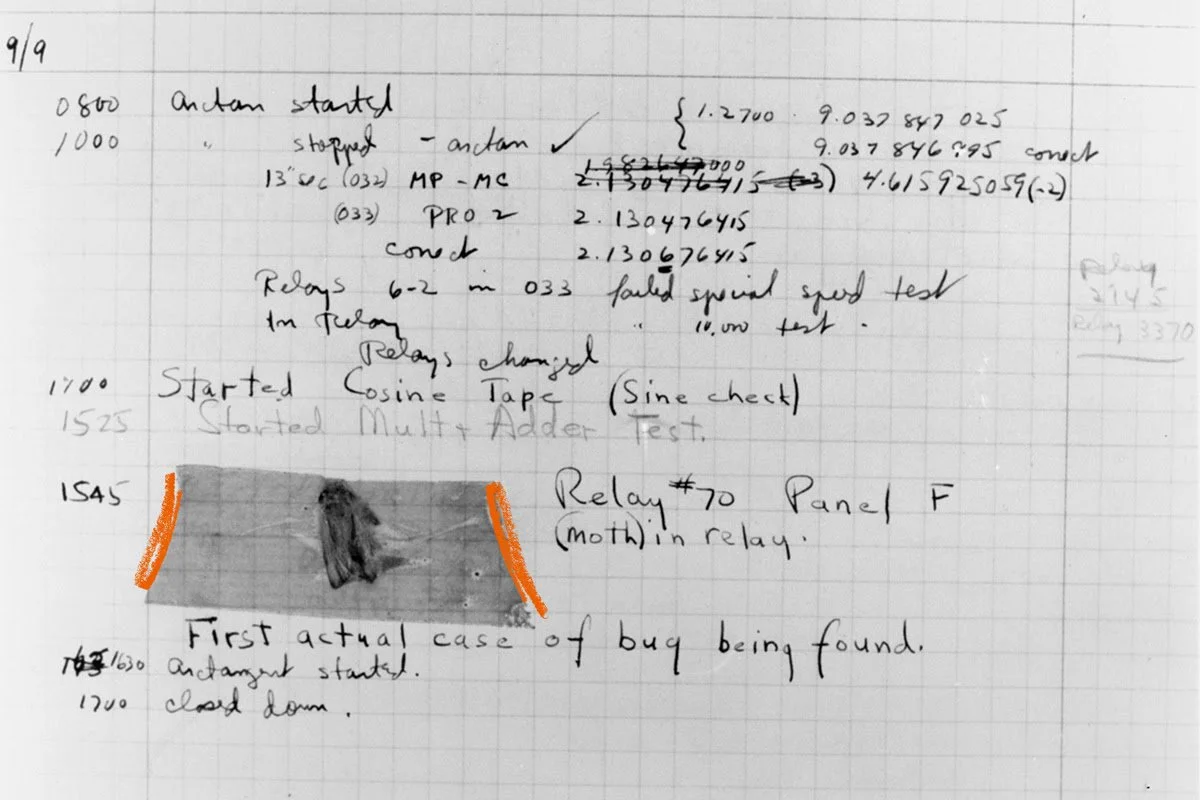
On September 9, 1947, the Harvard Mark II, one of the earliest computers, encountered a bug. Quite literally.
People have used the term “bug” since the 19th century to describe mechanical problems. Thomas Edison wrote about a bug in the call apparatus of his telephone in a letter in 1878, and the Pall Mall Gazette ran a story in 1889 referencing Edison finding a bug in his phonograph. The term even appeared in the Supplement to the Oxford English Dictionary.
So, when the Mark II began malfunctioning on that September day, the engineers working on it, including the legendary programmer and mathematician Grace Hopper, knew they were looking for a bug—they just didn’t realize it would be so literal.
But finding the issue took more than sitting at a desk and running a troubleshooter, like we do today. Instead, the engineers had to walk to the physical location of the problem—somewhere in the 4,000 square feet of floor space the electromechanical computer took up.
About 3:45 that afternoon someone found the bug. It was a moth, stuck in Relay 70, Panel F. Each relay was a small mechanical switch, and anything interrupting the circuit was a major problem. Whoever found the insect taped it into their logbook, along with the note “First actual case of bug being found.” A popular story suggests that this person was Hopper, but it likely wasn’t: The book logging the moth was not written in her handwriting.
We may never know who this computing punster was, but the book and its offending insect are preserved at the Smithsonian National Museum of American History.
Source: Britiannica.com, “Today in History,” by Teagan Wolt