
Pat McGrath and his daughter, Moriah, have taken off on a Great Adventure! The first report is now in:
Flew from White Plains to Portland via O’Hare where I took my first Lyft ride to my hotel, which is a converted 100 year old grade school with a movie theater, library, brewery, and five pubs. My room is half of a former classroom with a blackboard along one wall, the biography of a former student on another, and no television.
Wednesday, Moriah and I went to Oregon City, the Western terminus of the Oregon Trail. Between 1840 and 1860, 250,000 migrants arrived there from Independence, Missouri, on a four-to-five month trip during which about 20,000 perished along the way.
The Willamette river flows through Oregon City on its way to the Pacific. From there, it is far more navigable than from The Dalles on the Columbia River. This is the point at which the trail had previously ended before an enterprising emigrant cut a toll road suitable for wagons around Mount Hood to what would become Oregon City.
But there are falls there whose volume is second only to Niagara in the United States. John McLoughlin, a Canadian who was tasked with populating the Oregon territory built a mill at the base of the falls to provide employment to the arrivals who weren’t to become farmers.
Over 150 years it grew and merged and was purchased, becoming in the mid-20th century part of Crown Zellerbach, the second largest paper company in the US and one of the largest employers in Oregon. Now it is abandoned and crumbling but still is a beautiful reminder of the historic role it played in turning a geophysical feature into both a means and an incentive to populate a vast, unpopulated (by Europeans) wilderness.
Here’s what it looks like from the promenade on the cliff above the river near the landmarked house of the house of John McLoughlin, who was named the Father of Oregon in 1957, the centennial of his death.
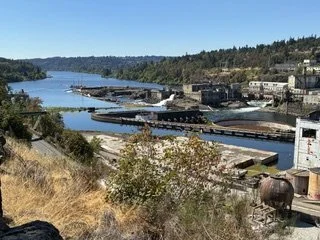
Photo by Pat McGrath
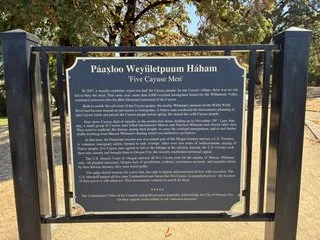
Apparently, the Patriotic American police haven’t gotten this far West yet, because this plaque is on the promenade from which I took the picture.
On our way to Victoria BC!
Editor’s Note on Pat’s Plaque:
Here’s what the plaque says:
OREGON CITY – The Confederated Tribes of the Umatilla Indian Reservation (CTUIR) and Oregon City have worked together for three years on a project to honor five Cayuse men who were unjustly taken into custody, charged and hanged in Oregon City Territory in 1850.
The names of the five men who volunteered to talk about the killings that occurred at the Whitman Mission in 1847 were: Tiˀílakaˀaykt, ˀIceyéeye Siléqis, Koyomá Šamqíin, Tamáhas and ƛókomooc. (These Cayuse and Nez Perce names are represented with standard Americanist symbols.) According to CTUIR historians, Marcus Whitman was suspected of coveting Cayuse lands and poisoning Cayuse people by spreading disease. Following Whitman’s death, a militia formed and launched what came to be known as the Cayuse War.
Starting in 1991, CTUIR Board Trustee Armand Minthorn worked with former Oregon City Mayors Dan Fowler and Alice Norris on ways to commemorate. Subsequently, CTUIR Trustee átway (late) Les Minthorn, who carried the family name Koyomá Šamqíin, told at least two Oregon City groups that approached the CTUIR with ideas of reconciliation and dramatic re-enactment that what the CTUIR most wanted was “to find our ancestors and bring them home for proper burial.” Both Minthorns descend from the families of the hanged men.
“It’s important that we remember all aspects of our history, not just the pleasant parts. I’m pleased that we have been able to partner with the Confederated Tribes of the Umatilla Indian Reservation to create a memorial that pays respects to these five men in a manner they find appropriate, and ensures the men are never forgotten,” said Oregon City Mayor Denyse McGriff.
The tribute will include a historical interpretive panel and boulder. A plaque on the boulder will present a hopeful message that the burial location of the five men may be found. Efforts to identify the graves are ongoing but are challenged by conflicting historical accounts of the location and changes in the infrastructure and landscape over time.
“Honoring these five men in this way reflects our love and respect – for ancestors who made sacrifices so we could be here, for the leaders who made this tribute possible, and for those who carry on the work our elders directed us to continue,” said Toby Patrick, CTUIR Board of Trustees Member at Large and Cultural Resources Committee Chairman.
The project site is on the McLoughlin Promenade, a 7.8-acre linear park overlooking the historic location of their public hanging near Willamette Falls. The site’s proximity to the places where the men were detained, tried and hanged is of great importance to the CTUIR and was carefully considered by Oregon City officials in the selection process.
In 2021, the Oregon City Commission approved funding to construct the tribute project. Construction will begin on May 6 and a dedication is planned for June.
The Confederated Tribes of the Umatilla Indian Reservation is comprised of the Cayuse, Umatilla and Walla Walla Tribes, and formed under the Treaty of 1855 at the Walla Walla Valley, 12 Stat. 945. In 1949, the Tribes adopted a constitutional form of government to protect, preserve and enhance the reserved treaty rights guaranteed under federal law.