
The Long Road to Sliced Bread
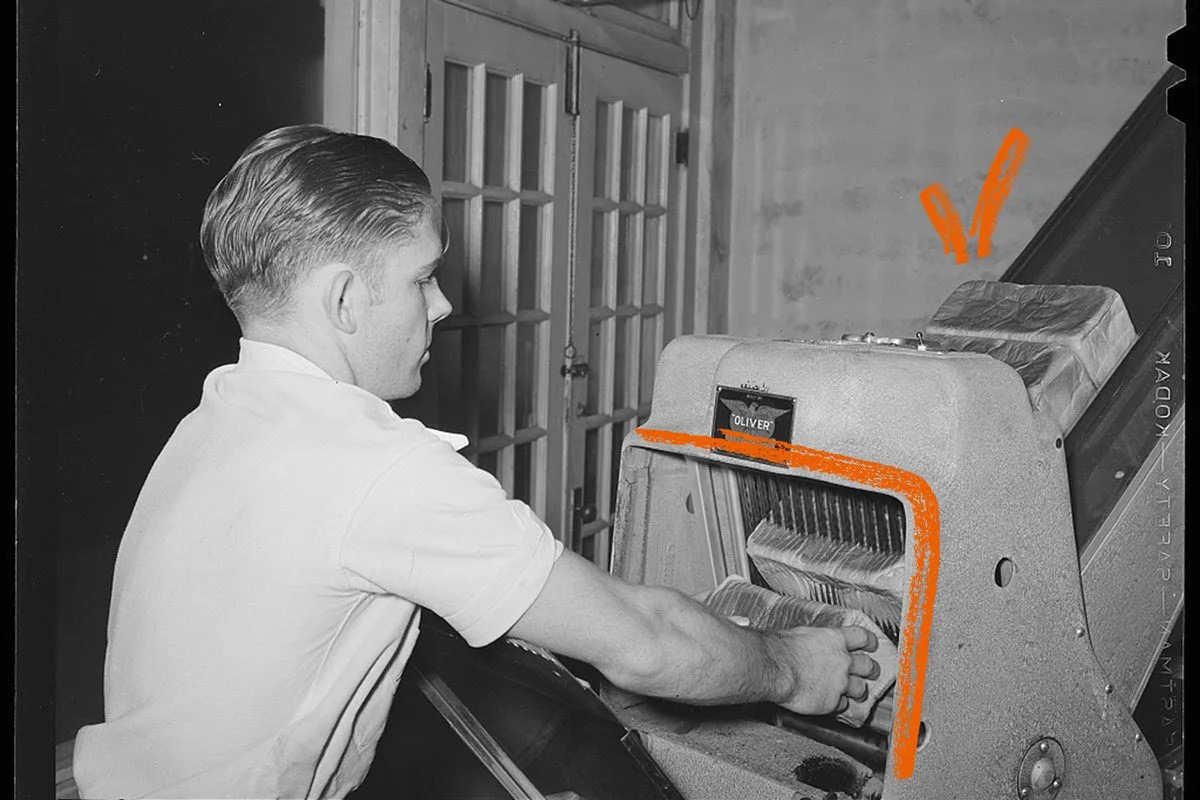
Prints and Photographs Division/Library of Congress, Washington, D.C.

Bread has been made for thousands and thousands of years. But the convenience of commercially available presliced bread? That is a much more recent development, relatively speaking.
On July 7, 1928, bread loaves that had been presliced—with the first commercial bread slicer—were sold for the very first time. And the person responsible for this, one of the most revolutionary inventions in the baking industry, was . . . a jeweler? Indeed. The creator, Otto Rohwedder, was a jeweler by trade, but he liked to invent things in his spare time. He had graduated with a degree in optics from the Northern Illinois College of Ophthalmology and Otology. (Rohwedder was a man of many interests.) He eventually left the jewelry business entirely and took a chance on an idea: a machine that would automatically slice loaves of bread. By 1917 he had a viable prototype and a factory that was ready to produce it. So why didn’t his invention debut then? That year a fire destroyed the factory that housed Rohwedder’s prototype and blueprints. The setback meant he would have to start over.
Rohwedder got back to work. He partnered with Frank Bench, the owner of the Chillicothe Baking Company in Missouri, which would go on to produce the first loaves of bread that would be sliced by Rohwedder’s invention in 1928. The day before the first sales of their presliced bread, they advertised in a local newspaper, touting the innovation as “The Greatest Forward Step in the Baking Industry Since Bread Was Wrapped” and “a fine loaf sold a better way.”
Customers agreed.
As the demand for sliced bread increased, the use of commercial bread slicers spread across the country. The sale of presliced bread has been ubiquitous ever since—with one small hiccup in 1943, when there was a brief ban on it in the U.S. (But that’s a story for another time. Stay tuned.)
Source: Britannica.com, “Today in History,” Amy McKenna