World Jellyfish Day celebrates a beautiful, mysterious, and sometimes dangerous invertebrate. The day also encourages us to learn more about these unique aquatic animals.
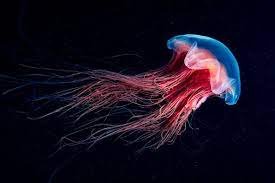
Jellyfish are made up of about 95% water. They’re actually not fish at all, but invertebrates (meaning: without bones). Yes, they have a nerve network, but no central nervous system or brains. Also, they are without a circulatory system or a respiratory system. A jellyfish’s umbrella-shaped, jelly-like body — known as a bell — contains its stomach. Dangling from the bell are tentacles with cnidocytes, a type of exploding cell.
Jellyfish range in size: The Irukandji jellyfish weighs less than a tenth of an ounce, with a bell two-tenths of an inch in diameter. On the other hand, the lion’s mane jellyfish can weigh over 440 pounds and have a bell diameter of more than 6 ½ feet. No matter their size, because of these stinging tentacles any jellyfish is best appreciated from a distance.
Found in all 5 oceans around the world, most jellyfish eat plankton, fish larvae, and fish eggs. Their prey are sharks, sea turtles, dolphins, and tuna and other fish. Jellyfish migrate together in blooms, moving from the bottom of the ocean to its surface. Many, but not all, bloom in the spring, reproduce in the summer, and die in the fall. Some have a lifespan of a few hours, others can live for a few years. Many are dangerous to humans, with one of the most dangerous being the sea wasp, a box jellyfish.
Jellyfish have been around for a very long time — even longer than dinosaurs. Scientists’ theory that jellyfish originated some 500 million years ago was proven right with the 2007 discovery of perfectly preserved 505-million-year-old jellyfish fossils in Utah. Jellyfish’s mostly see-through bodies, wiry tentacles, and lack of bodily organs confounded early scientists – back when categories were only plants, animals, and humans — so much they couldn’t even classify them,. They didn’t seem to fit any one of those groups, and were classified as simply “incomplete” and ignored.
However, in 1859, Charles Darwin proposed his theory of evolution — “all living things show a variation in physical traits over time as a process of natural selection” — and jellyfish got some recognition. In 1866, the German zoologist and naturalist Ernst Haeckel wrote a book, Generelle Morphologie der Organismen (or, in English, General Morphology of Organisms). In it, he illustrated the evolution of many organisms — jellyfish included — to show how primitive animal forms gradually came to be versions known in modern times. His theory was that jellyfish had split from the rest of the organisms at an earlier date, which was the reason they looked so different from other species. And the research continued. In that process, at least in the scientific community, Jellyfish lost their “fish” designation, since they have no bones at all, much less a backbone. Scientists now sometimes refer to them as jellies.
Today, jellyfish are looked upon, all over the world, as somewhat of an invasive species, since they need very little oxygen to live and spread. They can survive in any water, enjoy a broad diet, reproduce very quickly, and shrink when food reserves reduce, only to revive themselves when food is available again. There are over 200 species of them — and some of them are even edible. They come in an array of colors, including, but not limited to, pink, yellow, blue, and purple. Jellyfish are usually luminescent, which makes them especially beautiful. On the down side, some jellyfish stings are very painful and others can be deadly.
NOVEMBER 4: KING TUT DAY