Our Newest US Holiday

Our Newest National Holiday: Juneteenth 

“In 2022, the US celebrated a new national holiday: Juneteenth. Some people know a lot about Juneteenth. Some know a little about Juneteenth. Some know not a thing about it. Here’s what the Smithsonian says:

“On ‘Freedom’s Eve,’ or the eve of January 1, 1863, the first Watch Night services took place. On that night, enslaved and free African Americans gathered in churches and private homes all across the country awaiting news that the Emancipation Proclamation had taken effect. At the stroke of midnight, prayers were answered as all enslaved people in Confederate States were declared legally free. Union soldiers, many of whom were black, marched onto plantations and across cities in the south reading small copies of the Emancipation Proclamation spreading the news of freedom in Confederate States. Only through the Thirteenth Amendment did emancipation end slavery throughout the United States.

But not everyone in Confederate territory would immediately be free. Even though the Emancipation Proclamation was made effective in 1863, it could not be implemented in places still under Confederate control. As a result, in the westernmost Confederate state of Texas, enslaved people would not be free until much later. Freedom finally came on June 19, 1865, when some 2,000 Union troops arrived in Galveston Bay, Texas. The army announced that the more than 250,000 enslaved black people in the state, were free by executive decree. This day came to be known as "Juneteenth," by the newly freed people in Texas.

Juneteenth marks our country’s second Independence Day. Although it has long celebrated in the African American community, this monumental event remains largely unknown to most Americans.”

* * * * *

So, in honor of Juneteenth on Monday, June 19, we celebrate three monuments of different kinds in our area that remind us of our history of enslavement and rejoice in its end:

1) The Enslaved African Rain Garden, in Yonkers

2) The commemoration of the end of slavery, celebrated this past June X in Irvington

3) Philipseburg Manor, which offers insight into the use of enslaved labor in our area

THE ENSLAVED AFRICANS RAIN GARDEN, YONKERS, NY

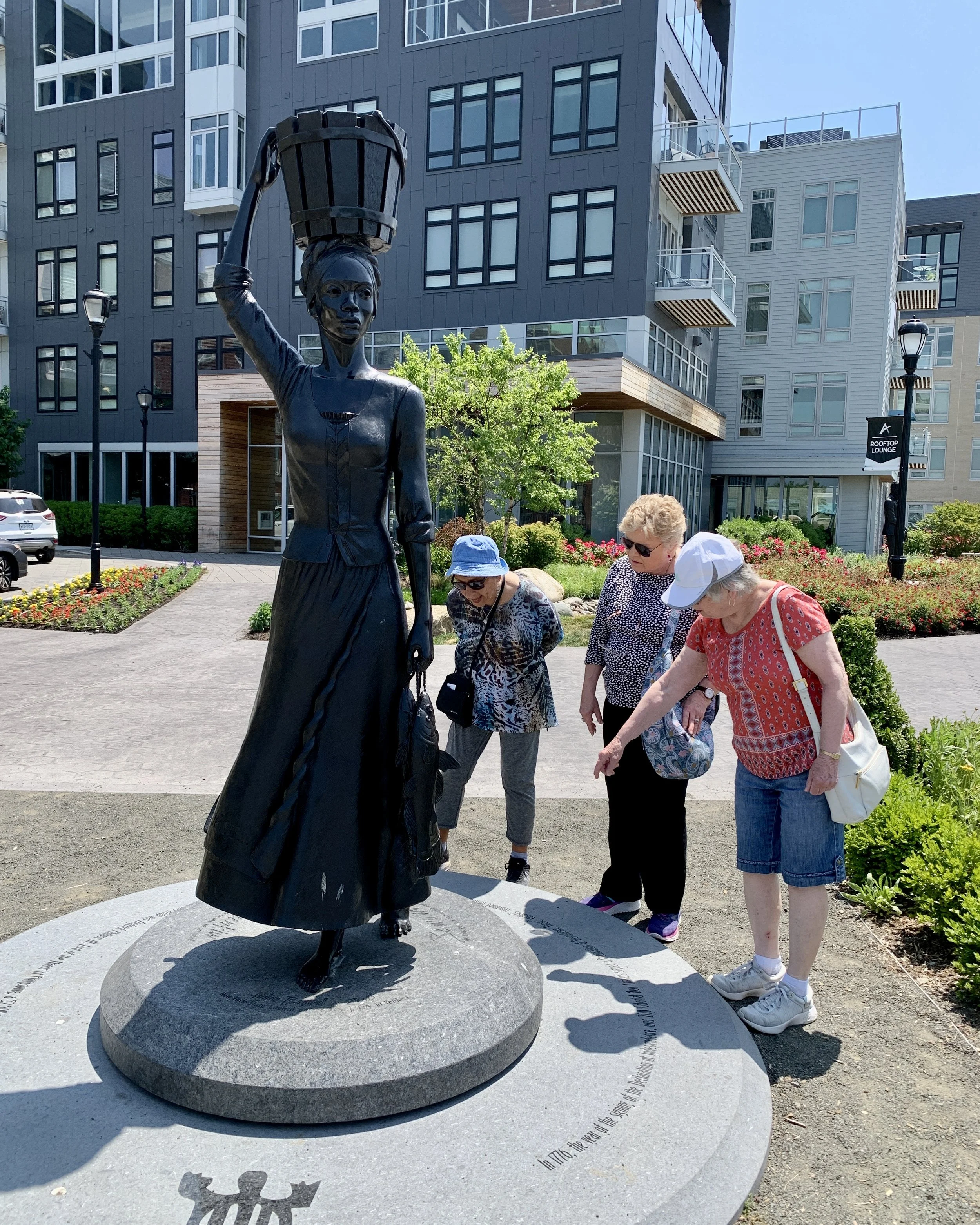
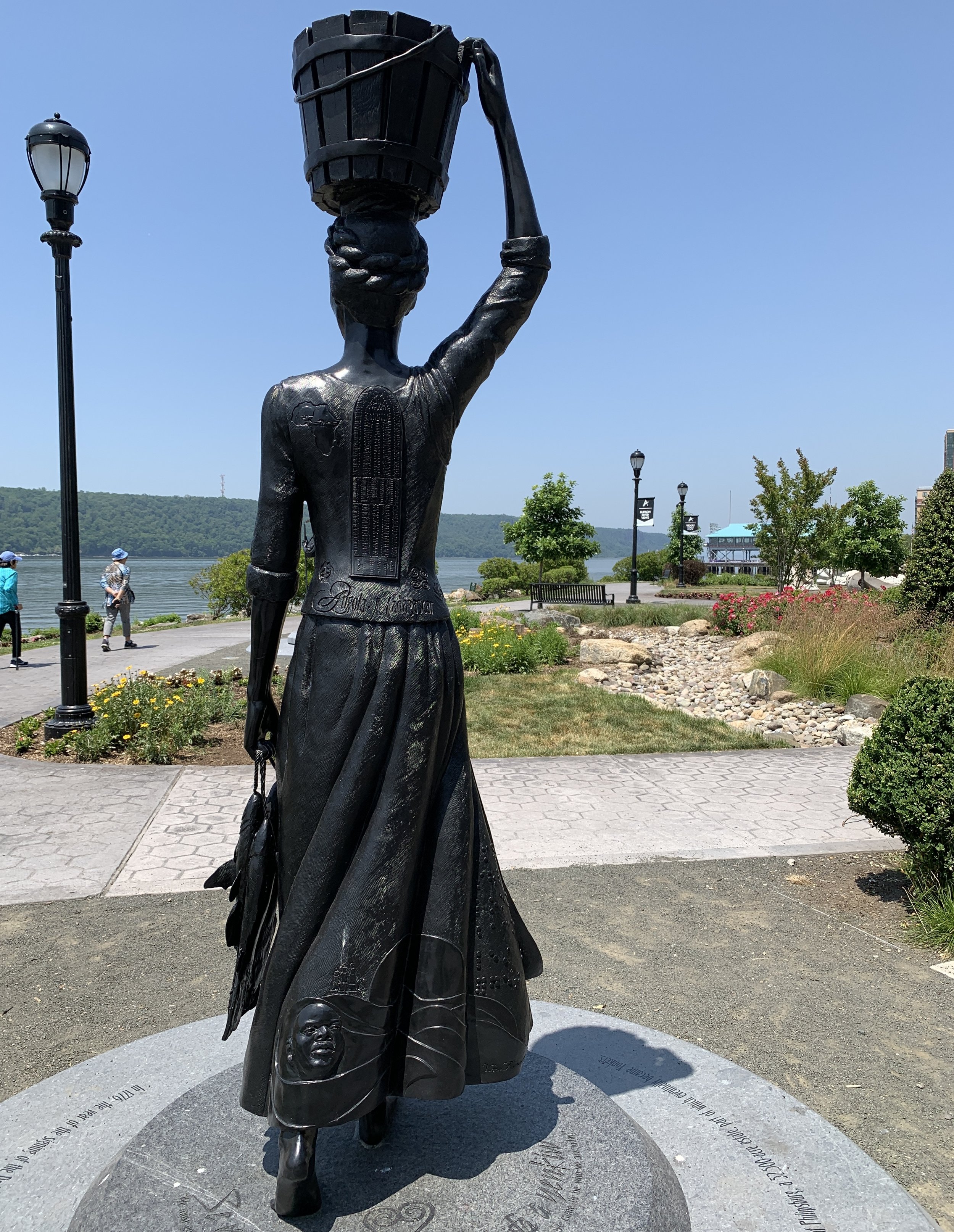
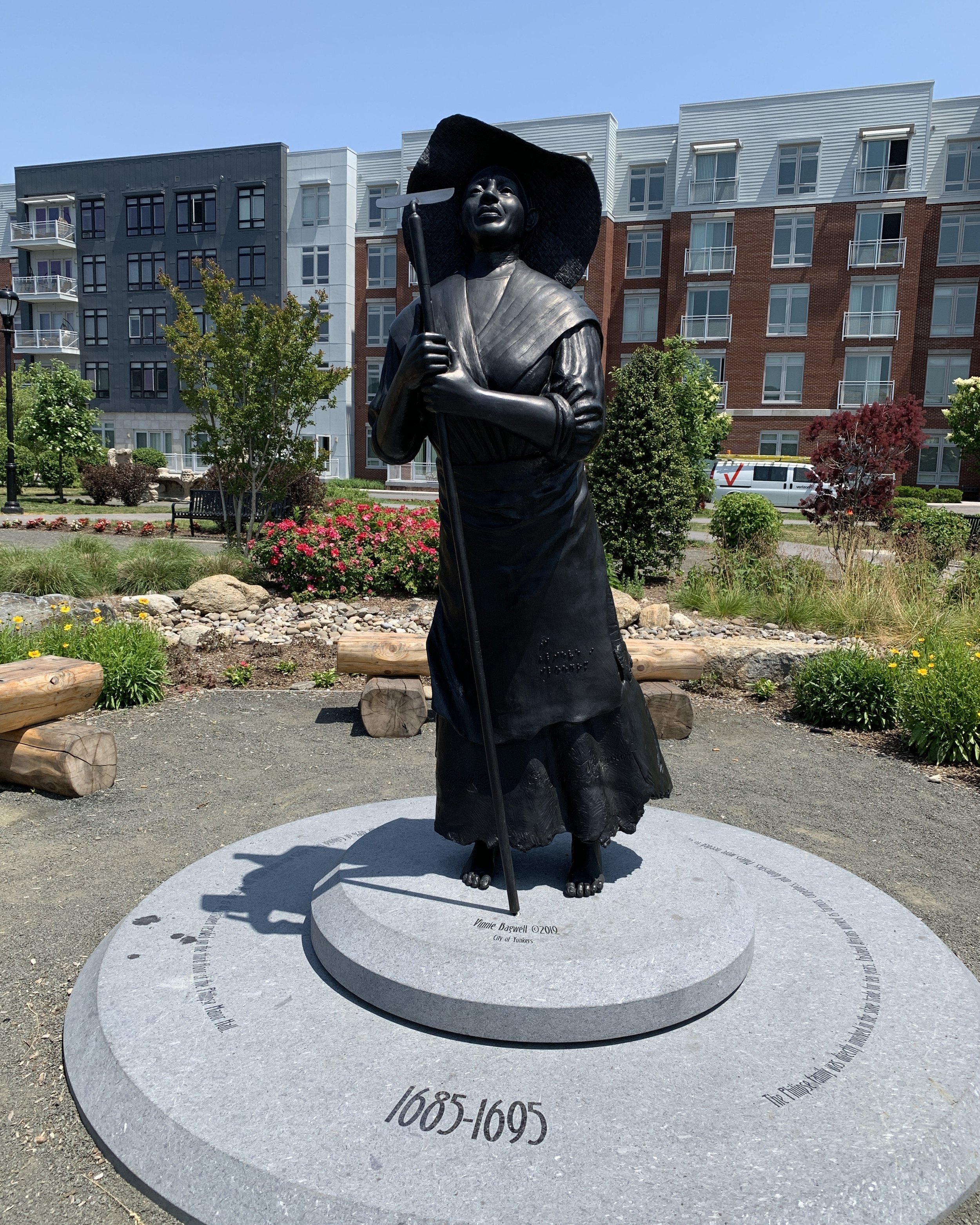
On June 1, Kendal residents visited The Enslaved Africans Rain Garden in Yonkers. It stands across from the Philipse Manor Hall. The life-size sculptures, by sculptor Vinnie Bagwell, honor the enslaved Africans who lived and worked at the Hall. More information can be found by clicking here.
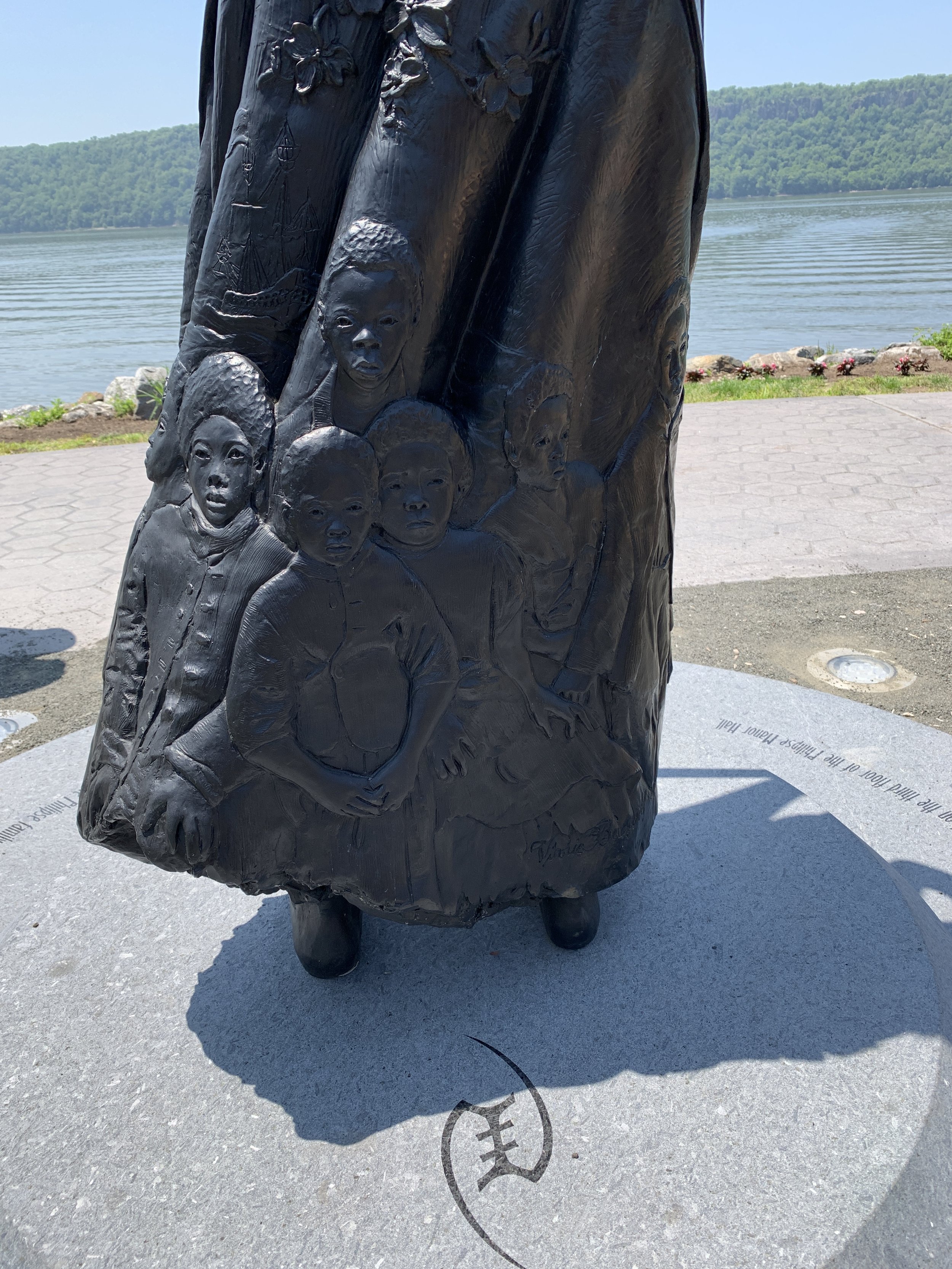
Skrit details
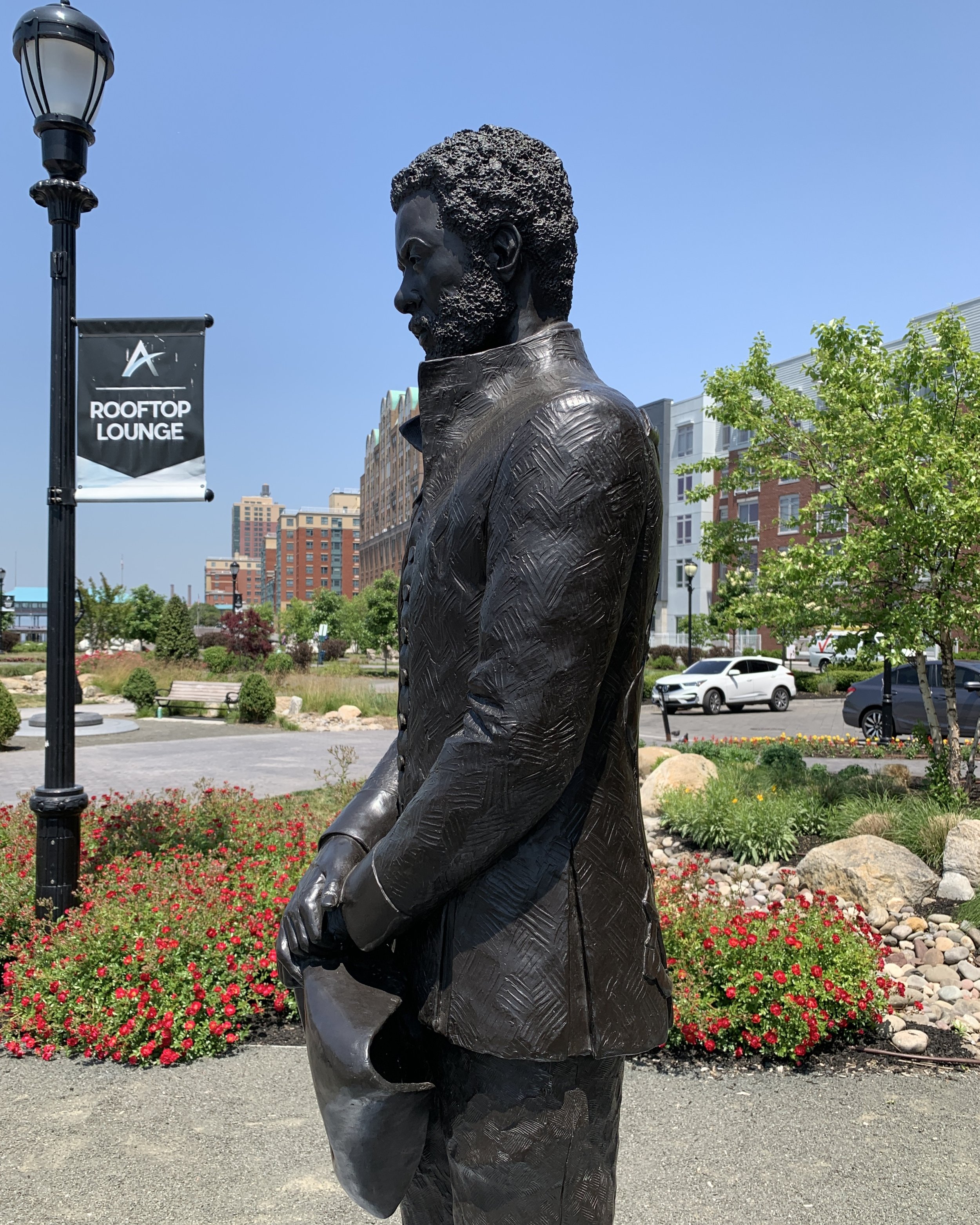
Photos by Harry Bloomfeld

ENSLAVED AFRICANS IN IRVINGTON, NY

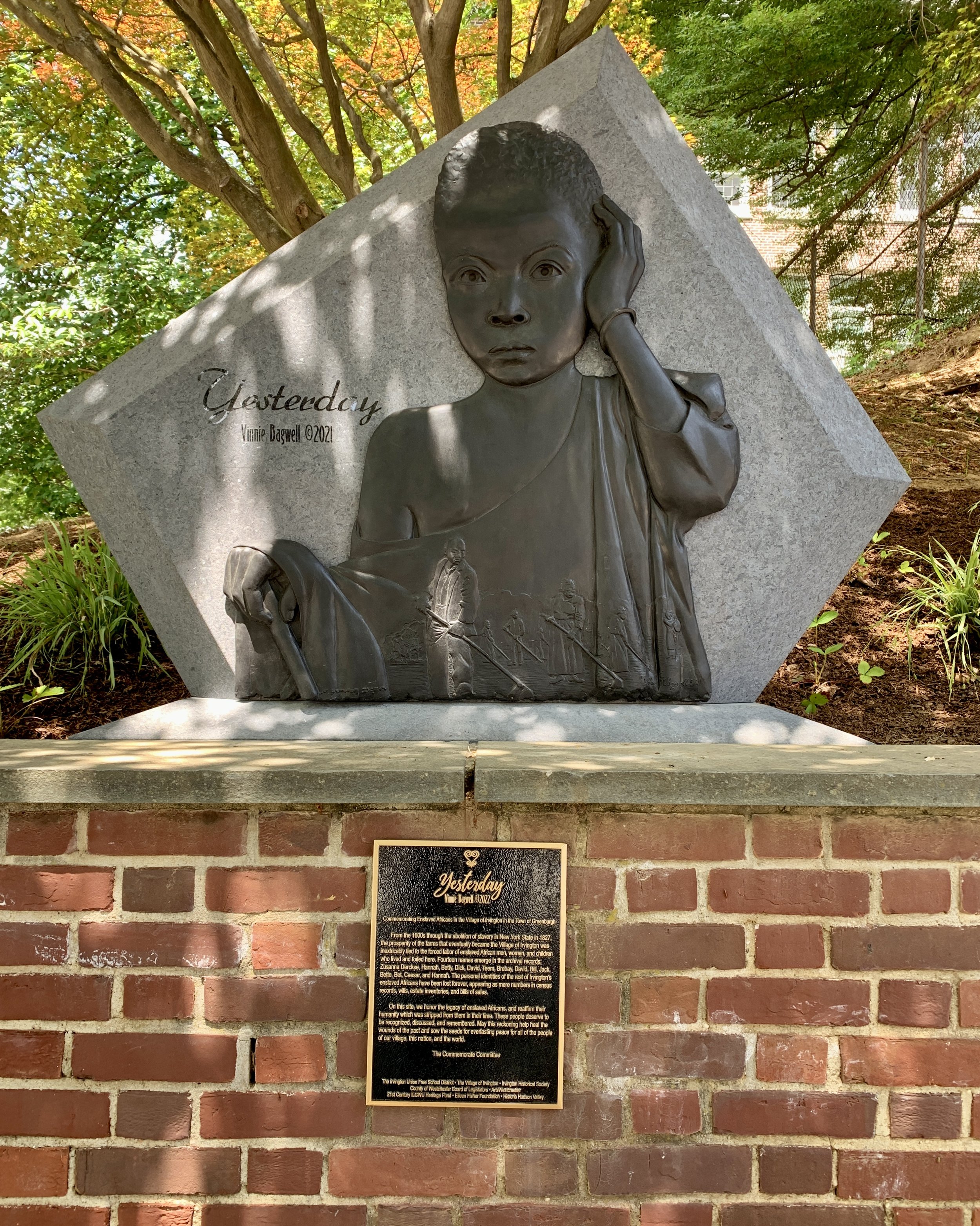
On June 10, the Village of Irvington unveiled and dedicated a plaque commemorating enslaved Africans in the village. After speeches by local residents and politicians, the artist Vinnie Bagwell unveiled the plaque.

Vinnie Bagwell is the same artist who created the sculptures in Yonkers.
Artist Vinnie Bagwell

Photos by Harry Bloomfeld

PHILIPSBURG MANOR, UPPER MILLS, SLEEPY HOLLOW, NY: A HERITAGE SITE OF SLAVERY

From the Philipsburg Manor website:

“At Philipsburg Manor, the story of slavery in the colonial north is given not only a full interpretive treatment, but a face: 23 of them, to be exact. Visitors learn about the lives of Caesar, Susan, Dimond, Betty, and the other enslaved Africans who lived at the Upper Mills in 1750. All were listed on an inventory of Adolph Philipse’s property drawn up after his death that year.

Visitors to Philipsburg Manor learn how this group of enslaved Africans came to be there, the important role they played in a commerce network that stretched around the world, and the human tragedy that unfolded as the estate was sold and divided up. It is a compelling story made even more powerful because it is told in the very spot where the events played out.

In an excellent blog post, history professor Ana Lucia Araujo of Howard University examines the troubling absence of public awareness about slavery in the northern states. She talks about Philipsburg Manor’s critical role as “an important heritage site of slavery” and its importance to scholars and others “studying history, heritage, and the memory of slavery.” Click here to read the post.”

Photos by Harry Bloomfeld

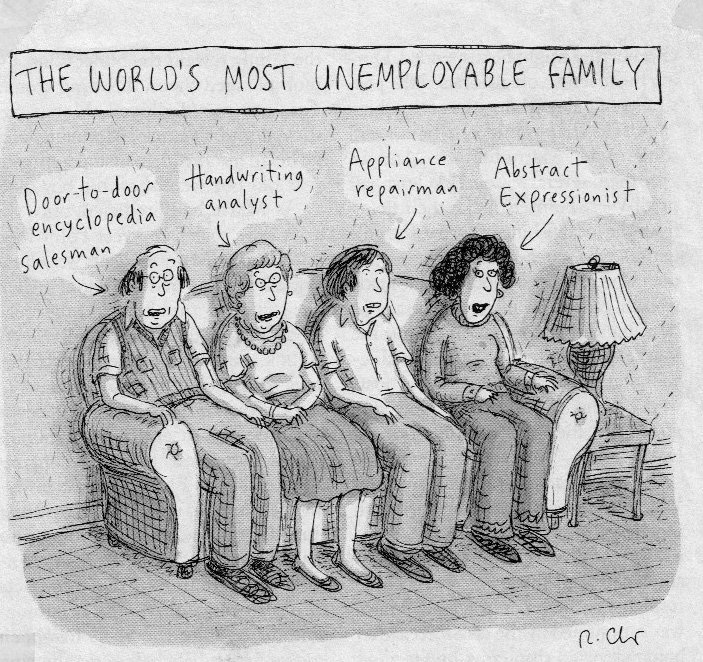
For Your Funny Bone . . .

In the land of Great Funny Bones Laugh Alike, contributed by both Bobbi Roggemann and Maria Harris

Contributed by Barbara Bruno

Contributed by Barbara Bruno

Contributed by Sally Kellock

Contributed by Barbara Bruno

Quotable Quotes

On Sleepy Hollow, NY:

“If ever I should wish for a retreat whither I might steal from the world and its distractions, and dream quietly away the remnant of a troubled life, I know of none more promising than this little valley.” 
― Washington Irving

Little Green . . . Containers

Remember back when we begged Fred for them? We swore we would return them immediately after first use.

Time to empty out the change you dump in them, the seedlings you germinate in them, the gold fish you breed in them (okay, maybe not that last one), and return the green, recyclable containers to the ATM room next to the lounge.

We are inspired to poetry:

Little Green Containers

They are in very short supply!

And so expensive more to buy!

And so, that, my friend, is simply why . . .

“Return them,” is the call we cry!


And if you don’t, we might just have to write some more poetry . . .

Special Observances, June 19 - 25

JUNE 19: WORLD SAUNTERING DAY

Saunter: to walk in a slow, relaxed manner, without hurry or effort. Every year, World Sauntering Day, sometimes also known as International Sauntering Day, celebrates this manner of mobility. Its purpose is to remind people to slow down and enjoy life rather than rush through it.  

Slow down. In fact, try moseying. Stroll. Amble. Meander. Those who saunter don’t hurry. They absorb the wonders of nature and contemplate the weather. Destination: we’ll see when we get there. Time? There’s no schedule. And what better place to saunter than Rockwood Park or the Rockefeller Preserve? Saunter Central.

W.T. Rabe created World Sauntering Day in 1979, inspired in opposition to the growing popularity of jogging. The idea behind the day was to encourage people to slow down and appreciate the world around them.

JUNE 20: NATIONAL VANILLA MILKSHAKE DAY

Though National Vanilla Milkshake Day celebrates the frothy beverage made with vanilla ice cream, vanilla, and milk, it wasn’t always that way. The word “milkshake” first showed up in 1885 as a drink for grown-ups: a mixture of cream, eggs, and whiskey. Almost a generation later, milkshakes had become “wholesome drinks made with chocolate, strawberry or vanilla syrups.” But no ice cream anywhere in the recipe. And no blenders—the drink mixer didn’t come along until 1911. Want a milkshake, shake it yourself! In the early 1900s, a scoop of ice cream became a standard request, and by the 1930s, the milkshake as we know it had spread countrywide.

Stephen Poplawski invented the electric blender in 1922, for the direct purpose of mixing beverages like malts and milkshakes. Milkshake migrated from soda fountain to the home and more and more restaurants added milkshakes to their menus. Today, the milkshake is a staple at many restaurants and ice cream parlors. It all started with vanilla, but has expanded to a range of flavors. Vanilla, however, is still the classic choice.

JUNE 21: INTERNATIONAL T-SHIRT DAY

Every year on the first day of summer, International T-Shirt Day celebrates, well, that should be rather obvious. The theme of the day: Wear their favorite t-shirt. Popular all around the world, the t-shirt dates back to 1898. Laborers would cut their union suits in half to stay cool during the heat of the summer.  The US Navy made it official in 1913 by issuing the t-shirt as an undershirt. 1920: F. Scott Fitzgerald coins the term t-shirt by including it as a piece of wardrobe in This Side of Paradise. Still, it remained a hidden piece of apparel until Marlon Brando and James Dean came along. Suddenly, the t-shirt was a fashion statement. Even then, many people considered wearing a t-shirt as wild and rebellious. In the 1950s, slogans and Disney characters helped create the graphic t-shirt. In the 1970s, t-shirts with slogans were worn as a statement, especially for protesting the Vietnam War.

Today t-shirts are worn for a slew of reasons: sheer comfort, versatility, and — as custom t-shirts — to show unity or advertise a cause. They can also be bought at concerts and sporting events. Some of the best-selling designs include INY, Superman, Rolling Stones, and Hard Rock Café.

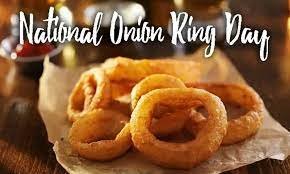
JUNE 22: NATIONAL ONION RINGS DAY

Have a craving for all things deep-fried? National Onion Ring Day is the holiday for you! It’s unclear when onion rings first came about, but an onion ring-like recipe appeared in an 1802 cookbook, and another surfaced in a New York newspaper in 1910. Texas-based restaurant chain Kirbys Pig Stand claims a big part in onion rings’ creation, and fast food restaurant A&W helped them reach widespread popularity. There is still an ongoing debate over who deserves credit for the snack’s creation, and cooks also still argue about how to best prepare and serve onion rings for the most flavorful results. Some onion rings are even made from an onion paste, as opposed to an onion ring itself! This style of preparation can make it easier to eat the rings without accidentally yanking the onion out of the fried batter. However onion rings first came to be — and however you prefer yours prepared — they’re now a beloved snack across the US, the UK, Canada, Australia, Ireland, South Africa, some regions of Asia, and other corners of the world. They’ve also inspired countless spin-off snacks, like blooming onions and Funyun chips. So, no matter how you like them, grab a fried onion snack for National Onion Rings Day!

JUNE 23: PINK FLAMINGO DAY

Pink Flamingo Day is a fun way to appreciate the pink flamingos used as garden decor. They are a staple icon in pop culture and are popular among working-class homeowners. The pink flamingo was designed in 1957 by Don Featherstone from photos in “National Geographic.” It was one of the first projects he worked on at Union Products in Leominster, Massachusetts. He was a sculptor fresh out of art school hired by the company to create 3D plastic lawn and garden ornaments. He named the first pink flamingo Diego, and his design won him the Ig Nobel Prize for Art in 1996. He died at 79, only a few hours before Pink Flamingo Day.

The meaning of the pink flamingo has changed somewhat over the years. It was considered at one time a symbol of bad taste. In 1972, a director called John Waters released the movie entitled “Pink Flamingos.” It became infamous for its outrageousness featuring a drag queen and carrying the tagline “An exercise in poor taste.” By 1980, avant-garde galleries seized on the concept and started to display flamingo-themed installations. Baby boomers could be seen carrying pink flamingos across Europe in their backpacks. They also kayaked with them through the wilderness.

Around the 1990s, the plastic pink version became popular as housewarming gifts. The pink flamingo has different meanings to different people. It represents an influential part of popular culture. It has become a symbol for showing a sense of humor, crossing boundaries, and for those daring to be different.

JUNE 24: INTERNATIONAL FAIRY DAY

Fantasy, imagination, and a little bit of pixie dust come together in honor of International Fairy Day. These tiny supernatural creatures have captivated myth and legend for generations.  Today the wee folks’ stories perpetuate animated stories, miniature garden displays, and children’s books. The idea behind International Fairy Day is to celebrate mythical creatures such as fairies, and to use their tales to teach valuable lessons to the children.

Fairies are mythical creatures said to possess magical powers. Having different origin stories from different parts of the world, there are different versions hailing from different places to describe the existence of fairies. Some call them the children of Eve, some call them fallen angels, and some consider them the sisters of elves. As far as Peter Pan goes, legend has it that the first laugh of a baby broke into several pieces and became the source of the existence of fairies and demons.

JUNE 25: COLOR TV DAY

Color TV Day marks the birth of color television and its role in our culture since its inception. It will come as no shock to Kendalites that, though most of us take color television for granted these days, this wasn’t always the case. Black-and-white TV was the first and only television programs until the middle of the 20th century, when color television began.  

The first successful experiments with color TV were conducted in 1928 by Scottish inventor John Logie Baird. It wasn't until mid-century that commercial broadcasts began in America. Following the tremendous success of black-and-white broadcasting in the US, CBS researchers, under the direction of Peter Goldmark, approved a heavy and massive mechanical television system in 1950, with the first color transmission taking place in June of the following year. From then on, watching movies and shows has never been more vivid or entertaining!

Because of the expense of color television sets and the limited quantity of color television material available, black and white television sets remained popular until the mid-1960s. Color television quickly gained popularity in the US and eventually expanded around the globe. Europeans awaited the solidification of American standards, then introduced the color format in 1967, which was eventually adopted worldwide. In 1972, sales of color television sets in the US overtook black-and-white sets for the first time.

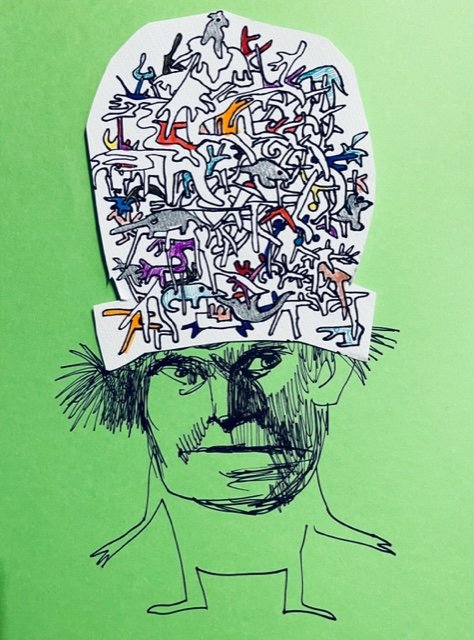
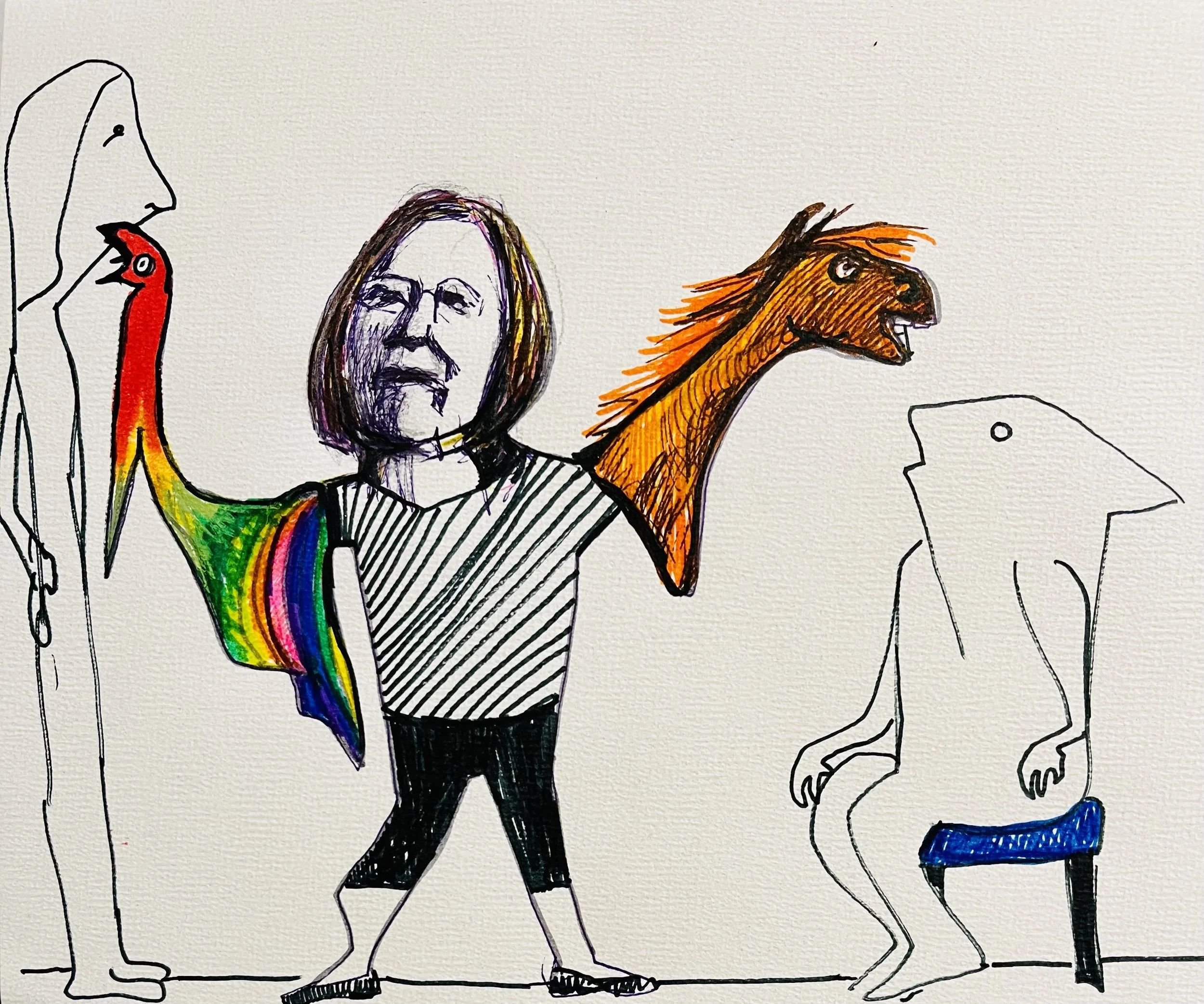
Art by Hart

At MOMA this morning, I met a starving artist

Lambert wanted to impress the new lady dentist

There was a lot that Allred was told to keep under his hat

Missy's golden doodle-caterpillar mix was a leaper and a climber

The zoo had to downsize during renovations, but the animals didn't seem to mind

Everyone adored the new witch doctor

Art and photos by Jane Hart

In and Around Kendal: the People of Kendal

Usually at this point we focus on the beauties of the landscape and riverscape of Kendal. Today, we focus on what makes Kendal tick, tock, blossom, and bloom: our Kendal people — residents of our tiny village, their adventures (mild and wild), and their families.

A Kendal Birthday

Because she takes off for the summer, Cynthia Ferguson and friends celebrated #85 a wee bit early.

Photo by Bobbi Roggemann

A New Kendal Arrival

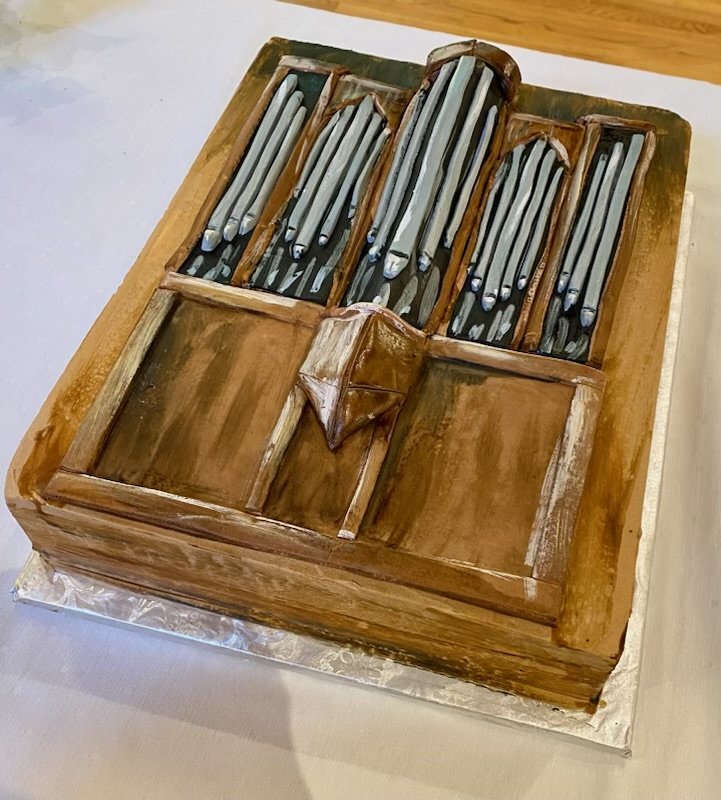
A newcomer to Kendal, we welcome Donald Butt, who has retired as organist and choirmaster at Church of St. Barnabas after 55 years of service. 

Chris Mitchell, as a member of the choir, extolled Donald’s service.

A very appropriate retirement cake for the Organ Master.

Quincy, Hildegarde Gray’s Grandson, Discovers the Goats of Rockwood Park

Photo by Hildegarde Gray

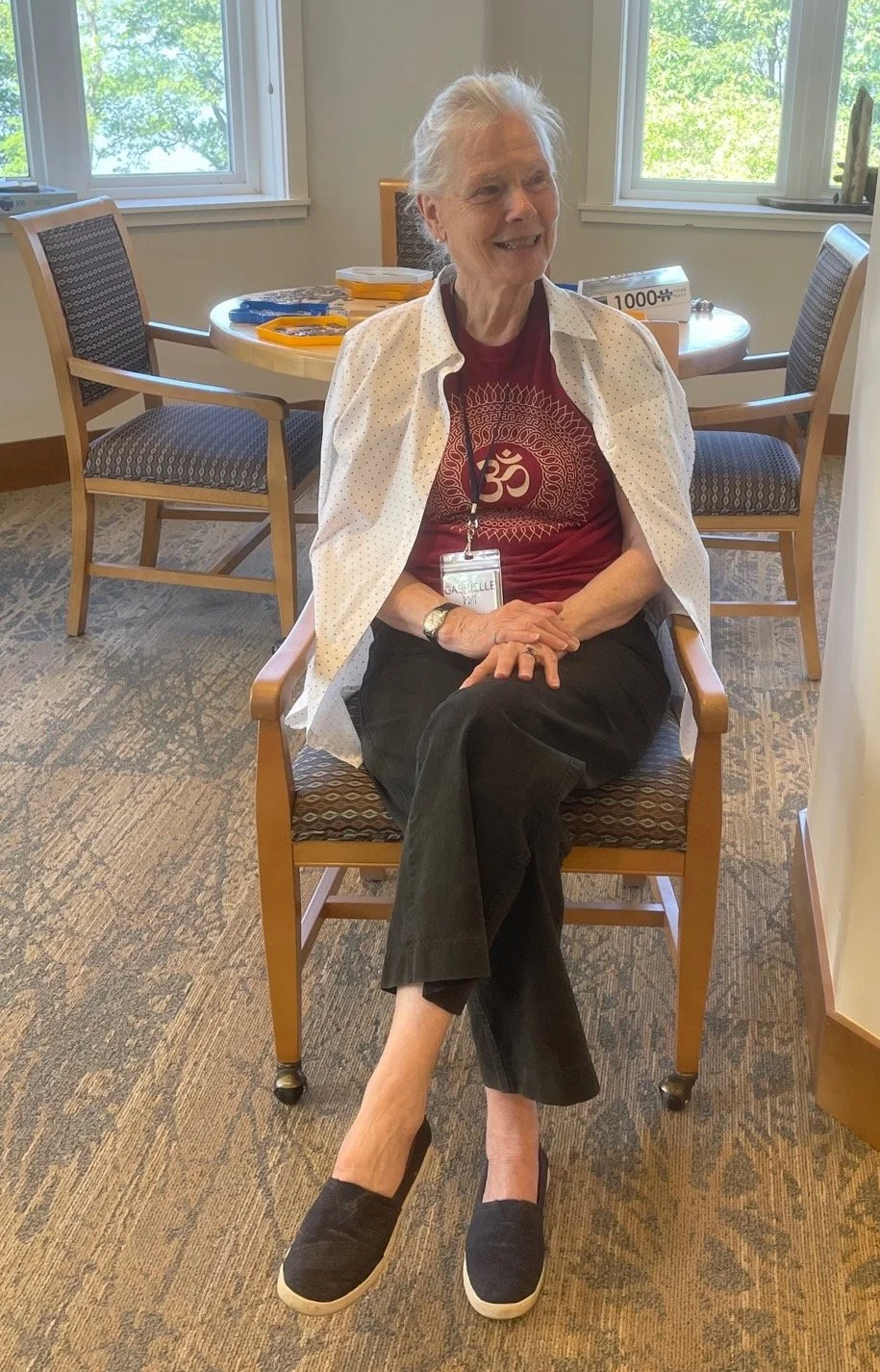
Gabrielle Hill Demonstrates the Kendal Art of Relaxation

Photo by Maria Harris

Awards Night for Young (and Old) at Sleepy Hollow High School

Jane Hart went to Awards Night as Sleepy Hollow High School begins to tie up the academic year. She was proud to applaud her niece, Luthi Mjeweni, a graduating senior, for her awards achieved. And, to Jane’s delight, she saw that the KOH Music Committee had donated a prize and that there was a KOH-donated award to a future nurse, as well. Topping off the night was a Rotary-donated prize in honor of Aubrey Hawes and his years of philanthropy in Sleepy Hollow and Tarrytown. Talk about your win-win evening!

Photo by Jane Hart (the proud aunt)

Pachyderm Poses

Is Downward Facing Dog your thing? Do you thrill to Salute the Sun? If yoga is your go-to passion, consider the elephant. The yoga-trained elephant. Seems zoos across the nation have concerns about the deleterious effort of no exercise on their elephants’ health, and are turning to yoga to improve both health and longevity.

At the Houston Zoo, for example, Elephant Supervisor Kristin Windle can assess the flexibility, energy, and skin condition of the 12 Asian elephants in her care through yoga moves. Her charges start young—about four months. With each successful move, treats are provided: bananas, bread, raisins, sweet potatoes, cantaloupe. By the time the elephants are 2-years-old, they can do the elephant version of yoga poses just on voice cues and pointing. Yoga sessions are conducted 3 times a day, lasting from 30 seconds to 5 minutes. If an elephant is not in the mood, just like at Kendal, he or she can just walk away. Usually, however, they’re enthusiastic yoga practitioners.

Curious about elephant yoga? Click the button below for a training taste of it.

Contributed by Steve Price via Jane Hart

Kendalites Further Afield

Jeff O’Donnell sent in the garden picture below, taken from the “Big House” at Oak Alley Plantation, a National Historic Landmark on the west bank of the Mississippi outside New Orleans. Oak Alley, a sugar plantation was built by and relied on enslaved men, women and children. One of the Conversation Series (in which the staff offers a variety of talks on all things Oak Alley) focuses on some of the individuals who were owned and kept on the plantation, their lives and living conditions. It also includes a look into life after emancipation, as laborers continued to live in the increasingly squalid housing until the 20th century.

Photo by Jeff O’Donnell

Special Observances, June 12-18

JUNE 12: NATIONAL RED ROSE DAY

Each year National Red Rose Day, honors the flower that is a symbol of love, romance, and beauty: the red rose, also the June birth flower. This special day, around since the early 2000s, is celebrated worldwide. Red roses were used in many early cultures for wedding decorations attire. Giving red roses is a traditional message of love still practiced today. They are also known for their fragrance and are cultivated for perfumes as well as brewing healing teas. Furthermore, roses come in a wide variety. From low-growing shrubs with dainty blossoms to long-stemmed robust plants, roses offer deep scarlets and bright berry-colored reds.

In June, red roses are in bloom in flower gardens across the US. Their beauty and sweet scent fill the air with happiness. Whether red, white, pink, yellow, or variations thereof, we have a splendid rose garden in our vicinity at Lyndhurst in Tarrytown: https://lyndhurst.org

JUNE 13: NATIONAL KITCHEN KLUTZES OF AMERICA DAY

June 13 honors those of us who would like to cooK, but just can’t seem to get the knack. It is National Kitchen Klutzes of America Day. Kitchen Klutzes are the people who set out with the intention of being like Julia Child. Reality quickly sets in dreams go up in the smoke that billows from the oven, knife cuts turn bloody, and cookies and fingers are burnt. The Kitchen Klutz has struck. It may be necessary to keep a first aid kit and fire extinguisher handy when Kitchen Klutzes are around.

There’s no record of the origin or even the purpose of the day, but that hasn’t kept us from celebrating it. The day reminds us that, in the kitchen or elsewhere, problems and accidents happen to us all. Be prepared to call 911 and have your favorite take-out ready as a backup.

 JUNE 14: FAMILY HISTORY DAY

Family History brings the past to life and makes it relevant. When young people begin researching their roots, they turn into detectives, treasure hunters, and historians on the quest to ferret out their “missing” family members. Along the way, they learn about the sacrifices, triumphs, determination, and quiet existence of people who helped make them who they are today. When less-than-young people do the same, the aha moments abound.

Knowing about our ancestors helps us keep things in perspective: Every family has people who have done well, done badly, lived through unimaginable tragedies, fought on the wrong side, sacrificed, struggled, and succeeded. Whether your family is crafty, digitally minded, exploration driven or a combination of all three, you will find something to kick start the re-discovery of your extended family. Enjoy!

JUNE 15: FLY A KITE DAY

Legend has it that Benjamin Franklin discovered electricity on June 15, 1752. Thanks to him, it’s Fly a Kite Day! Franklin first began conducting electricity experiments in 1747 and continued on for almost a decade. Thankfully, he documented his work and ideas in letters, which is why we know that 1749 was a big year. That’s when he first documented what he believed were similarities between electricity and lightning: the light’s color, crooked direction, crackling noise, and other things. He suspected lightning was electrical in nature, and wanted to prove it, knowing he could if the lightning passed through metal: i.e., a kite and a key. He knew the kite could get close to storm clouds, and he knew a metal key would attract the charge. And he was right! His discovery led to his invention of the lightning rod, which protects people, buildings, and ships to this day. Franklin’s also credited with coining electricity-related terms we still use today, including electrician, conductor, condenser, charge, discharge, uncharged, negative, minus, plus, electric shock, and battery.

Fly a kite to celebrate! Better yet, give your grandchild, niece or nephew a kite to celebrate, and cheer on the flight! But also take the time to appreciate Benjamin Franklin and his passion for science.

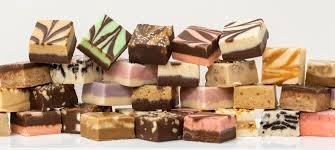
JUNE 16: NATIONAL FUDGE DAY

The dense candy-like treat known as fudge is believed to have been a mistake. According to legend, a confectioner flubbed while trying to make caramel, but ended up creating something just as tasty. We celebrate this happy accident on National Fudge Day. Fudge also has historical ties to female scholars. In the late 19th and early 20th century, fudge recipes spread like wildfire among students at women’s colleges such as Vassar, Wellesley, and Smith. One student made 30 pounds of the stuff for the Vassar Senior Auction in 1890!

National Fudge Day comes around each year, allowing aficionados to indulge in their favorite flavor of the delicious treat. Some of the most familiar flavors are chocolate, chocolate nut, peanut butter, maple, and maple nut. Fudge flavors lend themselves to experimentation, however. Blending favorites or even a moment of inspiration will create a new delicious kind of fudge.

JUNE 17: WORLD JUGGLING DAY

World Juggling Day encourages jugglers to unite and celebrate the joy of juggling. The day also encourages people to learn how to juggle. Estimates suggest only about 21% of the public can juggle. Want to learn? Experts say start with scarves—first two, then move to three. Don’t have scarves? Juggle plastic bags from the grocery store. Then move on to balls, rings, or beanbags. Many expert jugglers also use knives, flaming torches, and even chainsaws. Don’t start with those.

Historians believe juggling dates back to 2000 BC in ancient Egypt. It can also be traced back to the Aztec Empire. Also probably in Greek and Roman cultures. During the Middle Ages, jugglers were sometimes thought to be witches. In the Renaissance, juggling became a way to please royalty., but also entertained common folk throughout Europe. In fact, the word juggler comes from the word “jogelen,” which means “to entertain.” In 1793, juggling came to the US with the circus. Vaudeville included jugglers as well. Through-out the years, juggling has maintained its popularity for both amateurs and professionals. People can get into juggling at any age. The only prerequisite is passion.

World Juggling Day began in 1995 with the International Juggling Association (I.J.A.). Initially, it was commemorated as National Juggling Day. However, seeing its worldwide appeal, the I.J.A. renamed it World Juggling Day.

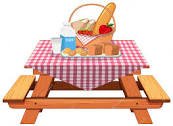
JUNE 18: INTERNATIONAL PICNIC DAY

International Picnic Day is easy to celebrate — with a picnic! Picnics have been a staple of most cultures. However, the picnic, as we know it today, didn’t exist until the French Revolution when public parks finally became available to the masses (that’s us). It was then, and is today, a great way to bring people together for an enjoyable day. Worldwide, picnics are a relaxing change of pace from daily lives.

Although the French are credited with the creation of modern picnics, globalization and individual cultures are responsible for their grand popularity. In 2018, 55% of young Americans said a picnic was their favorite warm-weather activity. And there are very few, if any, cultures around the world that do not engage in picnicking in their own way. Picnics are a wonderful way to get outside and enjoy what your town has to offer you. Kingsland Point Park by the Hudson has picnic tables galore. Or just take a lunch or dinner down to our own Terrace!

The Gift: Poem and Artist Book, by Sheila Benedis

THE GIFT            

                    introducing our son

                  to mountain climbing

                 step by step over rocks

    ascending mountains by the age of four

                           happily hiking


       becoming a serious hiker as an adult

         climbing all four thousand footers

                   in the White Mountains           

              drawing his full concentration

    preferring the historic mountains of Europe

to the wide open spaces of American mountains


           sharing hiking with his children

                 nourishing their bodies

                   soothing their minds

           sharing a special experience

                               a gift


              seeing his photographs

         hiking the Utah Canyonlands

                 fuels my creativity

               inspiring my collages    

         three generations enriched

                            the gift

The Gift: Artist Book

Ain't It Ducky!

Ladies and Gentlemen, hold onto your hats! The sports competition of the year is just around the corner!

SUNDAY, JUNE 11, 11 AM

PATRIOTS PARK, TARRYTOWN

IT’S

That’s right, these superb athletes have been training all year. Sunday, they will brave the torturous Patriots Park waters of Andres Brook, each fighting for the glory that is the Rubber Ducky who crosses the finish line first.

The Break-Neck Race of 2022

Not only that! But you, Sir, and you, Madam, can be right in the exciting midst of the competition. Adopt a ducky and cheer him or her (hard to tell) on to victory. There are so many opportunities! Adopt a single duck, a cost-effective Six Quack, or go for the gold with Tub-O-Ducks—13 of your most amazing competitors. (And best yet: They will NOT go home with you—they can be messy, you know.) For more information about Ducky Adoption, click here.

BUT THAT’S NOT ALL! THERE’S MORE!

NOT ONLY WILL THERE BE GLORIOUS WEATHER, AN EXCITED CROWD, AND ALL THOSE GLORIOUS DUCKIES, THERE WILL BE

FOOD:

2022 Feast Galore!

Rubber Duckies are High-Class Anseriforms (look it up). They are in this for the glory, not sordid lucre. All adoption funds, food, and donations go to the Rotary Club of the Tarrytowns and all their great work in the communities of Tarrytown and Sleepy Hollow. Says who? Major sponsors such as Phelps Hospital and—hold onto your hats—Kendal on Hudson, that’s who!

Once more, for more information click here.

Quotable Quotes

Valerie Wallace has come up with a niche that needs filling on the Residents Website:

Interesting quotes about or from interesting people or about historical or contemporary happenings or oddities.

And Valerie has provide the first one, about a particular new fad of the seventeenth century in England. Seems in 1657, a London court prosecuted James Farr, a Barber:

“ . . . for making and selling a drink called coffee whereby in making the same he annoyeth his neighbors by evil smells.”

We wonder if Starbucks knows about this.

Valerie discovered the incident in Jonathan Healey’s The Blazing World: A History of Revolutionary England 1603 - 1689

Four River Towns We Know & Love

River Villages are very special, each with its own character, but sharing proximity to one of the most beautiful rivers in the world. Art Brady took these photos of four River Villages from a viewpoint across the Hudson. See if you can pick out buildings you recognize!

Tarrytown by the Bridge

Our next-door neighbor Irvington

Next up: Dobbs Ferry

Hastings has its similarities—and differences

Special Observances

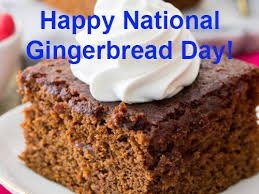
JUNE 5: NATIONAL GINGERBREAD DAY

‘Tis the season to celebrate National Gingerbread Day, when gingerbread lovers across the country celebrate by sampling their favorite recipes and gingerbread treats. Whether in the form of bread, cakes, bars, biscuits, or cookies, they’re delicious any time of year.

The term “gingerbread” originally referred to preserved ginger. Later, it typically used honey or molasses rather than just sugar and was flavored with ginger. It is believed that gingerbread was first brought to Europe in 992 by an Armenian monk. He lived there for seven years teaching gingerbread cooking to the French priests and Christians until his death in 999. Sources indicate that in 1444, Swedish nuns were baking gingerbread to ease indigestion. In the 17th century, gingerbread biscuits were sold in monasteries, pharmacies and town square farmers markets. During the 18th century, gingerbread became widely available. And today it is available at the drop of a cake, cookie, or muffin tin.

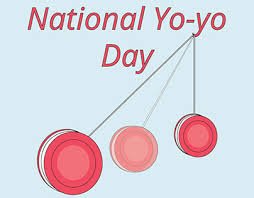
JUNE 6: NATIONAL YO-YO DAY

If it seems like yo-yos have been around forever, that’s because they have; we’re talking over 2,000 years! Some believe it all started in ancient Greece, but modern yo-yos likely came from the Philippines. In fact, the word “yo-yo” first appeared in a Filipino dictionary in 1860. But they didn’t become popular stateside until the 1930s. Pedro Flores (of Filipino descent) began mass producing yo-yos in 1928. After holding some promotional competitions, he caught the eye of Donald F. Duncan Sr, who thought these yo-yo things were awesome! Duncan bought Flores out, hired him to run the marketing campaigns, and the rest is National Yo-yo Day history.

Today the Duncan Toy Company is synonymous with this iconic toy. However, it wasn’t Duncan’s or Flores’ idea to hold a National Yo-Yo Day. No, that honor goes to Daniel Volk — a yo-yo pro whose talent helped spread the toy’s popularity. After all, he starred in “The Yo-Yo-Yo Man Instructional Video” alongside the Smothers Brothers (which can still be found on youtube).

National Yo-yo Day has been held on June 6 since 1990. It’s a day to channel your inner child and start celebrating!

JUNE 7: NATIONAL CHOCOLATE ICE CREAM DAY

To observe National Chocolate Ice Cream Day, all you need is chocolate ice cream. Why stop there? You can have it in a cone or make it from scratch. Add sprinkles or syrup or whipped cream.

Chocolate ice cream is the second most common flavor, surpassed only by vanilla. It has been in existence well over a hundred years and has been popular in the United States since the late 19th century. In producing it, cocoa powder is blended in with eggs, cream, vanilla, and sugar. Other flavors, such as rocky road or triple chocolate chunk, use chocolate ice cream in their creation.

While you can enjoy this day with a scoop or two, you could also explore the variety of chocolate ice creams available, too. How many kinds of chocolate ice cream could there possibly be? For starters, of course, there’s dark chocolate and milk chocolate. But then we can add peanut butter or marshmallow. Rocky Road is chocolate-based. And don’t forget all the kinds of fudge. Some people like chocolate and mint mixed together, too. The list goes on and on.

JUNE 8: BEST FRIENDS DAY

Whether they’re near or far, old or new, best friends help to carry us through our lives. National Best Friends Day is time to tell them how much we appreciate their company. As the Mayo Clinic reports: “Friends help you cope with traumas, such as divorce, serious illness, job loss, or the death of a loved one. They also encourage you to change or avoid unhealthy lifestyle habits, such as excessive drinking or lack of exercise.” Today’s the day to enjoy a little one-on-one time with the people who never fail to catch us when we fall.

We have our own country to thank for this lighthearted holiday. In 1935, the U.S. Congress gathered to devote a day each year in tribute to close friends. They chose June 8, which is usually a balmy day in all regions of the country—perfect for outdoor activities. Since then, many other countries have adopted the practice. Some even throw festivals to celebrate their chosen family. While the holiday seems to have lost popularity through the years, it has seen a recent upsurge in engagement since the advent of social media.

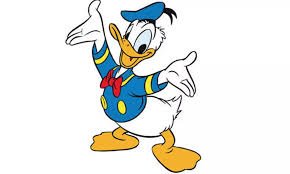
JUNE 9: DONALD DUCK DAY

Donald Duck made his cartoon debut in “The Wise Little Hen” back in the summer 1934. He didn’t meet Mickey Mouse until his second appearance in “Orphan’s Benefit” later that year. From there, it wasn’t long before Daisy Duck and his nephews Huey, Dewey, and Louie were introduced. In spite of their superior diction, they weren’t able to steal the spotlight from Donald. You can’t replace his grumpy, nearly incomprehensible charm, and it’s why the Donald has been in more movies (200+) than any Disney character.

More or less starting off as a comic-book character, he remains the most published non-superhero ever. Such is his popularity that Donald Duck is a national hero in Finland!

With his signature blue sailor suit (no pants), Donald Duck has appeared in more short films and feature films than any other Disney character. Walt Disney conjured up the idea for Donald Duck to introduce an edgier character to balance out the goody-goody jolly Mickey Mouse.

Another defining feature of Donald Duck is his voice. Clarence Nash, the original voice actor for Donald, created a distinct voice achieved by ‘buccal speech,’ a form of vocalization that utilizes the inner cheek to create sound instead of the larynx. Nash first discovered this while trying to mimic his pet goat.

In the 1940s, Donald Duck overtook Mickey Mouse with over 128 independent short animations. This was truly the decade of the Donald, as he soared to popularity faster than any other Disney figure. During World War II, despite having to halt most of its production, Donald Duck was featured in several American propaganda films. One of these animations earned Disney an Academy Award for Best Short Film. Other than his success in films, Donald also got his own comic in the 1940s that branched into an entire series of independent Donald Duck comics, which are circulated and enjoyed by adults and children until today.

JUNE 10: NATIONAL BALL POINT PEN DAY

Before 1943, anyone who wanted to write a letter or scribble some notes on a piece of paper used a fountain pen or pencil. Now the dominant writing instrument is the ballpoint pen, originally conceived and developed as a cleaner and more reliable alternative to the quill and fountain pens. In earlier years, many attempts by inventors led to failed patents. Their inventions did not deliver the ink evenly. They also had overflow and clogging issues.

In June of 1943, the brothers Laszlo and Gyorgy Biro obtained their patent for the ballpoint pen, revolutionizing how many write letters and conduct business. Today, manufacturers produce ballpoint pens by the millions and sell them worldwide. As a promotional tool, ballpoint pens find their way into our hands from advertisers of all sorts assuring that we always have a ballpoint pen handy, too.

JUNE 11: CORN ON THE COB DAY

The founder or creator of National Corn on the Cob Day is still unknown. That doesn’t make chowing down on this special treat any less delicious.

Corn on the cob is a treat in the summertime that people from all corners of the US look forward to as we start the picnic season. There are several names for this summer treat, among them corn stick, pole corn, sweet pole, long maize, or butter-pop. Corn on the cob can be served as a side dish by boiling, grilling, or roasting the corn.

The proper dinner protocol for eating corn says it is proper to hold the cob at each end with your fingers. Or save your fingers by those cute plastic corn on the cob handles—or any design of corn holders.